


Page 166 - 2025 Ranger Medic Handbook
P. 166
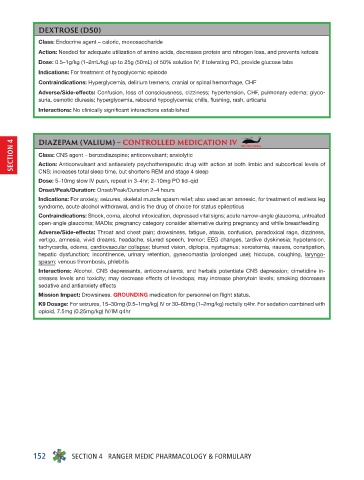
DEXTROSE (D50)
         Class: Endocrine agent – caloric, monosaccharide
         Action: Needed for adequate utilization of amino acids, decreases protein and nitrogen loss, and prevents ketosis
         Dose: 0.5–1g/kg (1–2mL/kg) up to 25g (50mL) of 50% solution IV; if tolerating PO, provide glucose tabs
         Indications: For treatment of hypoglycemic episode
         Contraindications: Hyperglycemia, delirium tremens, cranial or spinal hemorrhage, CHF
         Adverse/Side-effects: Confusion, loss of consciousness, dizziness; hypertension, CHF, pulmonary edema; glyco-
         suria, osmotic diuresis; hyperglycemia, rebound hypoglycemia; chills, flushing, rash, urticaria
         Interactions: No clinically significant interactions established


    SECTION 4  DIAZEPAM (VALIUM) – CONTROLLED MEDICATION IV
         Class: CNS agent – benzodiazepine; anticonvulsant; anxiolytic
         Action: Anticonvulsant and antianxiety psychotherapeutic drug with action at both limbic and subcortical levels of
         CNS; increases total sleep time, but shortens REM and stage 4 sleep
         Dose: 5–10mg slow IV push, repeat in 3–4hr; 2–10mg PO tid–qid
         Onset/Peak/Duration: Onset/Peak/Duration 2–4 hours
         Indications: For anxiety, seizures, skeletal muscle spasm relief; also used as an amnesic, for treatment of restless leg
         syndrome, acute alcohol withdrawal, and is the drug of choice for status epilepticus
         Contraindications: Shock, coma, alcohol intoxication, depressed vital signs; acute narrow-angle glaucoma, untreated
         open-angle glaucoma; MAOIs; pregnancy category consider alternative during pregnancy and while breastfeeding
         Adverse/Side-effects: Throat and chest pain; drowsiness, fatigue, ataxia, confusion, paradoxical rage, dizziness,
         vertigo, amnesia, vivid dreams, headache, slurred speech, tremor; EEG changes, tardive dyskinesia; hypotension,
         tachycardia, edema, cardiovascular collapse; blurred vision, diplopia, nystagmus; xerostomia, nausea, constipation,
         hepatic  dysfunction;  incontinence,  urinary  retention,  gynecomastia  (prolonged  use); hiccups, coughing,  laryngo-
         spasm; venous thrombosis, phlebitis
         Interactions:  Alcohol, CNS depressants, anticonvulsants, and herbals potentiate CNS depression; cimetidine in-
         creases levels and toxicity; may decrease effects of levodopa; may increase phenytoin levels; smoking decreases
         sedative and antianxiety effects
         Mission Impact: Drowsiness. GROUNDING medication for personnel on flight status.
         K9 Dosage: For seizures, 15–30mg (0.5–1mg/kg) IV or 30–60mg (1–2mg/kg) rectally q4hr. For sedation combined with
         opioid, 7.5mg (0.25mg/kg) IV/IM q4hr


        152      SECTION 4   RANGER MEDIC PHARMACOLOGY & FORMULARY

