


Page 91 - JSOM Winter 2024
P. 91
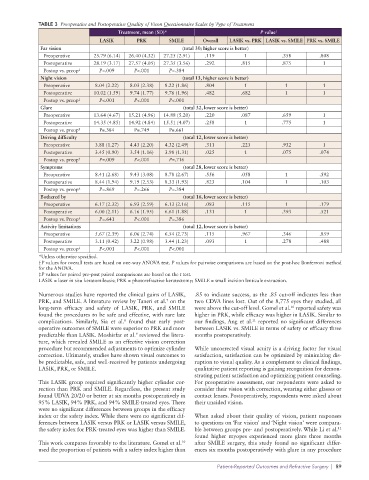
TABLE 3  Preoperative and Postoperative Quality of Vison Questionnaire Scales by Type of Treatment
                                        Treatment, mean (SD)*                         P value †
                                  LASIK       PRK       SMILE      Overall  LASIK vs. PRK LASIK vs. SMILE PRK vs. SMILE
              Far vision                                     (total 30; higher score is better)
                Preoperative    25.79 (6.14)  26.40 (4.32)  27.25 (2.91)  .119   1           .358        .808
                Postoperative   28.19 (3.17)  27.57 (4.05)  27.35 (3.56)  .292  .815         .875          1
                Postop vs. preop   ‡  P=.009  P<.001    P=.384
              Night vision                                   (total 13, higher score is better)
                Preoperative    8.04 (2.22)  8.03 (2.38)  8.22 (1.86)  .804      1            1            1
                Postoperative   10.02 (1.59)  9.74 (1.77)  9.76 (1.96)  .482    .682          1            1
                Postop vs. preop   ‡  P<.001  P<.001    P<.001
              Glare                                          (total 32, lower score is better)
                Preoperative    13.64 (4.67)  15.21 (4.96)  14.88 (5.20)  .220  .087         .659          1
                Postoperative   14.35 (4.85)  14.92 (4.84)  15.51 (4.07)  .258   1           .775          1
                Postop vs. preop   ‡  P=.384  P=.749    P=.661
              Driving difficulty                             (total 12, lower score is better)
                Preoperative    3.88 (1.27)  4.43 (2.20)  4.32 (2.49)  .311     .223         .932          1
                Postoperative   3.45 (0.90)  3.54 (1.16)  3.98 (1.31)  .025      1           .075        .074
                Postop vs. preop   ‡  P=.009  P<.001    P=.716
              Symptoms                                       (total 28, lower score is better)
                Preoperative    8.41 (2.68)  9.43 (3.08)  8.78 (2.67)  .556     .058          1          .592
                Postoperative   8.44 (1.94)  9.19 (2.53)  8.33 (1.93)  .823     .104          1          .103
                Postop vs. preop   ‡  P=.869  P=.266    P=.384
              Bothered by                                    (total 16, lower score is better)
                Preoperative    6.17 (2.32)  6.93 (2.59)  6.13 (2.16)  .083     .115          1          .179
                Postoperative   6.00 (2.11)  6.16 (1.95)  6.61 (1.88)  .131      1           .393        .521
                Postop vs. Preop   ‡  P=.641  P<.001    P=.386
              Activity limitations                           (total 12, lower score is better)
                Preoperative    5.67 (2.39)  6.06 (2.74)  6.54 (2.73)  .115     .967         .346        .859
                Postoperative   3.11 (0.42)  3.22 (0.98)  3.44 (1.23)  .093      1           .278        .488
                Postop vs. preop   ‡  P<.001  P<.001    P<.001
              *Unless otherwise specified.
              †P values for overall tests are based on one-way ANOVA test. P values for pairwise comparisons are based on the post-hoc Bonferroni method
              for the ANOVA.
              ‡P values for paired pre-post paired comparisons are based on the t test.
              LASIK = laser in situ keratomileusis; PRK = photorefractive keratectomy; SMILE = small incision lenticule extraction.
              Numerous studies have reported the clinical gains of LASIK,   .85 to indicate success, as the .85 cut-off indicates less than
              PRK, and SMILE. A literature review by Taneri et al.  on the   two CDVA lines lost. Out of the 8,775 eyes they studied, all
                                                       7
              long-term efficacy and safety of LASIK, PRK, and SMILE   were above the cut-off level. Gomel et al.  reported safety was
                                                                                                10
              found the procedures to be safe and effective, with rare late   higher in PRK, while efficacy was higher in LASIK. Similar to
                                                                                   11
                                          8
              complications.  Similarly,  Sia  et  al.   found  that  early  post-  our findings, Ang et al.  reported no significant differences
              operative outcomes of SMILE were superior to PRK and more   between LASIK vs. SMILE in terms of safety or efficacy three
                                             9
              predictable than LASIK. Moshirfar et al.  reviewed the litera-  months postoperatively.
              ture, which revealed SMILE as an effective vision correction
              procedure but recommended adjustments to optimize cylinder   While uncorrected visual acuity is a driving factor for visual
              correction. Ultimately, studies have shown visual outcomes to   satisfaction, satisfaction can be optimized by minimizing dis-
              be predictable, safe, and well-received by patients undergoing   ruption to visual quality. As a complement to clinical findings,
              LASIK, PRK, or SMILE.                              qualitative patient reporting is gaining recognition for demon-
                                                                 strating patient satisfaction and optimizing patient counseling.
              This LASIK group required significantly higher cylinder cor-  For preoperative assessment, our respondents were asked to
              rection than PRK and SMILE. Regardless, the present study   consider their vision with correction, wearing either glasses or
              found UDVA 20/20 or better at six months postoperatively in   contact lenses. Postoperatively, respondents were asked about
              95% LASIK, 94% PRK, and 94% SMILE-treated eyes. There   their unaided vision.
              were no significant differences between groups in the efficacy
              index or the safety index. While there were no significant dif-  When asked about their quality of vision, patient responses
              ferences between LASIK versus PRK or LASIK versus SMILE,   to questions on ‘Far vision’ and ‘Night vision’ were compara-
                                                                                                               12
              the safety index for PRK-treated eyes was higher than SMILE.  ble between groups pre- and postoperatively. While Li et al.
                                                                 found higher myopes experienced more glare three months
              This work compares favorably to the literature. Gomel et al.    after SMILE surgery, this study found no significant differ-
                                                            10
              used the proportion of patients with a safety index higher than   ences six months postoperatively with glare in any procedure
                                                                        Patient-Reported Outcomes and Refractive Surgery  |  89

