


Page 85 - JSOM Winter 2024
P. 85
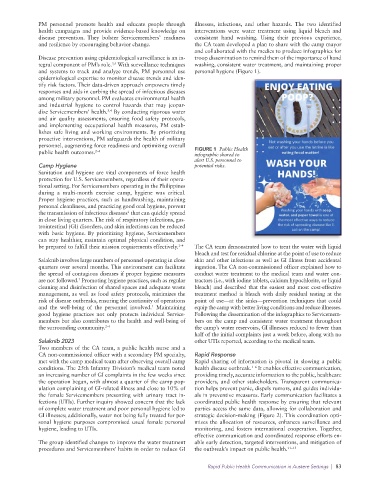
PM personnel  promote  health  and  educate  people through   illnesses,  infections,  and other  hazards.  The  two identified
              health campaigns and provide evidence-based knowledge on   interventions were water treatment using liquid bleach and
              disease prevention.  They bolster Servicemembers’ readiness   consistent hand washing. Using their previous experience,
              and resilience by encouraging behavior change.     the CA team developed a plan to share with the camp mayor
                                                                 and collaborated with the medics to produce infographics for
              Disease prevention using epidemiological surveillance is an in-  troop dissemination to remind them of the importance of hand
                                      3,4
              tegral component of PM’s role.  With surveillance techniques   washing, consistent water treatment, and maintaining proper
              and systems to track and analyze trends, PM personnel use   personal hygiene (Figure 1).
              epidemiological expertise to monitor disease trends and iden-
              tify risk factors. Their data-driven approach empowers timely
              responses and aids in curbing the spread of infectious diseases
              among military personnel. PM evaluates environmental health
              and industrial hygiene to control hazards that may jeopar-
                                    3,4
              dize Servicemembers’ health.  By conducting rigorous water
              and  air quality  assessments, ensuring  food  safety  protocols,
              and  implementing  occupational  health  measures,  PM  estab-
              lishes safe living and working environments. By prioritizing
              proactive interventions, PM safeguards the health of military
              personnel, augmenting force readiness and optimizing overall
              public health outcomes. 2–4                        FIGURE 1  Public Health
                                                                 infographic shared to
                                                                 alert U.S. personnel to
              Camp Hygiene                                       potential risks.
              Sanitation and hygiene are vital components of force health
              protection for U.S. Servicemembers, regardless of their opera-
              tional setting. For Servicemembers operating in the Philippines
              during  a multi-month  exercise  camp,  hygiene  was critical.
              Proper hygiene practices, such as handwashing, maintaining
              personal cleanliness, and practicing good oral hygiene, prevent
                                           1
              the transmission of infectious diseases  that can quickly spread
              in close living quarters. The risk of respiratory infections, gas-
              trointestinal (GI) disorders, and skin infections can be reduced
              with basic hygiene. By prioritizing hygiene, Servicemembers
              can stay healthier, maintain optimal physical condition, and
              be prepared to fulfill their mission requirements effectively. 1–4  The CA team demonstrated how to treat the water with liquid
                                                                 bleach and test for residual chlorine at the point of use to reduce
              Salaknib involves large numbers of personnel operating in close   skin and other infections as well as GI illness from accidental
              quarters over several months. This environment can facilitate   ingestion. The CA non-commissioned officer explained how to
              the spread of contagious diseases if proper hygiene measures   conduct water treatment to the medical team and water con-
                           1
              are not followed.  Promoting hygiene practices, such as regular   tractors (i.e., with iodine tablets, calcium hypochlorite, or liquid
              cleaning and disinfection of shared spaces and adequate waste   bleach) and described that the easiest and most cost- effective
              management, as well as food safety protocols, minimizes the   treatment method is bleach with daily residual testing at the
              risk of disease outbreaks, ensuring the continuity of operations   point of use—at the sinks—prevention techniques that could
              and the well-being of the personnel involved.  Maintaining   equip the camp with better living conditions and reduce illnesses.
                                                   1
              good hygiene practices not only protects individual Service-  Following the dissemination of the infographics to Servicemem-
              members but also contributes to the health and well-being of   bers on the camp and consistent water treatment throughout
              the surrounding community. 2–4                     the camp’s water reservoirs, GI illnesses reduced to fewer than
                                                                 half of the initial complaints just a week before, along with no
              Salaknib 2023                                      other UTIs reported, according to the medical team.
              Two members of the CA team, a public health nurse and a
              CA non-commissioned officer with a secondary PM specialty,   Rapid Response
              met with the camp medical team after observing overall camp   Rapid sharing of information is pivotal in slowing a public
              conditions. The 25th Infantry Division’s medical team noted   health disease outbreak.  It enables effective communication,
                                                                                   1–6
              an increasing number of GI complaints in the few weeks since   providing timely, accurate information to the public, healthcare
              the operation began, with almost a quarter of the camp pop-  providers, and  other stakeholders.  Transparent communica-
              ulation complaining of GI-related illness and close to 10% of   tion helps prevent panic, dispels rumors, and guides individu-
              the female Servicemembers presenting with urinary tract in-  als in preventive measures. Early communication facilitates a
              fections (UTIs). Further inquiry showed concern that the lack   coordinated public health response by ensuring that relevant
              of complete water treatment and poor personal hygiene led to   parties access the same data, allowing for collaboration and
              GI illnesses; additionally, water not being fully treated for per-  strategic decision-making (Figure 2). This coordination opti-
              sonal hygiene purposes compromised usual female personal   mizes the allocation of resources, enhances surveillance and
              hygiene, leading to UTIs.                          monitoring,  and fosters  international  cooperation. Together,
                                                                 effective communication and coordinated response efforts en-
              The group identified changes to improve the water treatment   able early detection, targeted interventions, and mitigation of
              procedures and Servicemembers’ habits in order to reduce GI   the outbreak’s impact on public health. 11–13

                                                                     Rapid Public Health Communication in Austere Settings  |  83

