


Page 80 - JSOM Winter 2023
P. 80
Internal Team Handoff                              for improvement. 4,14,15  When evaluating the quality of patient
          The fastest  internal team handoff occurred with both Blue-  handoffs of critically ill and injured patients that were either
          tooth  methods  of  communication  (Bluetooth  VOX,  mean   directly observed or recorded with subsequent review, Gold-
          22.19 [ range 12.13–30.98] seconds; and Bluetooth PTT, mean   berg et al. found very poor quality in patient handoffs from
          22.44 [range 14.32–53.69] seconds). Bluetooth VOX, Blue-  emergency medical services (EMS) to emergency medicine
                                                                      8
          tooth PTT, and radio PTT (mean 31.31 [range 16.36–54.28]   physicians.  Similarly, Benner et al. found that EMS patient
          seconds) were significantly faster than TM-ICS (mean 41.33     handoffs included only 44% of pertinent data, with only 51%
          [range 30.21–46.70] seconds; p<.001 ANOVA; p<.001 Blue-  of physicians being satisfied with the overall patient handoff. 16
          tooth VOX vs. TM-ICS, p<.001 Bluetooth PTT vs. TM-ICS,
          p<.01 radio PTT vs. TM-ICS, Bonferroni) (Table 2). Bluetooth   There is evidence that the quality of the patient handoff im-
          VOX was also significantly faster than radio PTT (p<.001   proves the delivery of care to the trauma patient. When the
          ANOVA;  p<.01 Bluetooth  VOX vs. radio PTT, Bonferroni)   MIST report (Mechanism, Injuries, Signs (vitals), and Treat-
          (Table 2).                                         ments) was instituted as standard practice for EMS transport-
                                                             ing patients to a single level 1 trauma center, Maddry et al.
          Patient Handoff Preference                         found a correlation with improved inpatient records report-
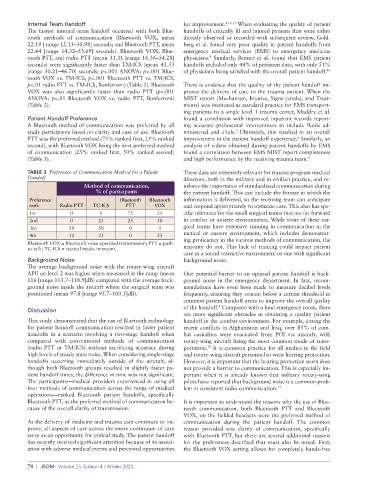
          A Bluetooth method of communication was preferred by all   ing accurate prehospital interventions to include fluids ad-
                                                                              7
          study participants based on clarity and ease of use. Bluetooth   ministered and vitals.  Ultimately, this resulted in an overall
                                                                                                  6
          PTT was the preferred method (75% ranked first, 25% ranked   improvement in the patient handoff experience.  Similarly, an
          second), with Bluetooth VOX being the next preferred method   analysis of videos obtained during patient handoffs by EMS
          of communication (25% ranked first, 50% ranked second)   found a correlation between EMS MIST report completeness
          (Table 3).                                         and high performance by the receiving trauma team. 9
          TABLE 3  Preference of Communication Method for a Patient   These data are extremely relevant for trauma program medical
          Handoff                                            directors, both in the military and in civilian practice, and re-
                            Method of communication,         inforce the importance of standardized communication during
                                % of participants            the patient handoff. This can include the format in which the
           Preference                   Bluetooth   Bluetooth   information is delivered, so the receiving team can anticipate
           rank      Radio PTT  TC-ICS    PTT      VOX       and respond appropriately to optimize care. This also has spe-
           1st          0         0        75       25       cific relevance for the small surgical teams that are far forward
           2nd          0        25        25       50       in combat or austere environments. While some of these sur-
           3rd          50       50        0         0       gical teams have extensive training in communication in the
           4th          50       25        0        25       tactical or austere environment, which includes demonstrat-
          Bluetooth VOX = Bluetooth voice operated transmission; PTT = push-  ing proficiency in the various methods of communication, the
          to-talk; TC-ICS = tactical medic intercom.         majority do not. This lack of training could impact patient
                                                             care in a sound-restrictive environment or one with significant
          Background Noise                                   background noise.
          The average background noise with the rotary-wing aircraft
          APU on level 2 was higher when measured at the ramp (mean   One potential barrier to an optimal patient handoff is back-
          116 [range 113.7–118.9]dB) compared with the average back-  ground noise in the emergency department. In fact, recom-
          ground noise inside the aircraft where the surgical team was   mendations have even been made to measure decibel levels
          positioned (mean 97.8 [range 95.7–100.5]dB).       frequently, ensuring they remain below a certain threshold in
                                                             common patient handoff areas to improve the overall quality
                                                                        4
          Discussion                                         of the handoff.  Compared with a loud emergency room, there
                                                             are more significant obstacles in obtaining a quality patient
          This study demonstrated that the use of Bluetooth technology   handoff in the combat environment. For example, during the
          for patient handoff communication resulted in faster patient   recent conflicts in Afghanistan and Iraq, over 85% of com-
          handoffs in a scenario involving a two-stage handoff when   bat casualties were evacuated from POI via aircraft, with
          compared with conventional methods of communication   rotary-wing aircraft being the most common mode of trans-
          (radio PTT or TM-ICS) without sacrificing accuracy during   portation.  It is common practice for all medics in the field
                                                                     10
          high levels of steady state noise. When considering single-stage   and rotary-wing aircraft personnel to wear hearing protection.
          handoffs occurring immediately outside of the aircraft, al-  However, it is important that the hearing protection worn does
          though both Bluetooth groups resulted in slightly faster pa-  not provide a barrier to communication. This is especially im-
          tient handoff times, the difference in time was not significant.   portant when it is already known that military rotary-wing
          The participants—medical providers experienced in using all   pilots have reported that background noise is a common prob-
          four methods of communication across the range of medical   lem in consistent radio communication. 17
          operations—ranked Bluetooth patient handoffs, specifically
          Bluetooth PTT, as the preferred method of communication be-  It is important to understand the reasons why the use of Blue-
          cause of the overall clarity of transmission.      tooth communication, both Bluetooth PTT and Bluetooth
                                                             VOX, on the fielded headsets were the preferred method of
          As the delivery of medicine and trauma care continues to im-  communication during the patient handoff.  The common
          prove, all aspects of care across the entire continuum of care   reason provided was clarity of communication, specifically
          serve as an opportunity for critical study. The patient handoff   with Bluetooth PTT, but there are several additional reasons
          has recently received significant attention because of its associ-  for the preferences described that must also be noted. First,
          ation with adverse medical events and perceived opportunities   the Bluetooth VOX setting allows for completely hands-free

          78  |  JSOM   Volume 23, Edition 4 / Winter 2023

