


Page 52 - JSOM Winter 2023
P. 52
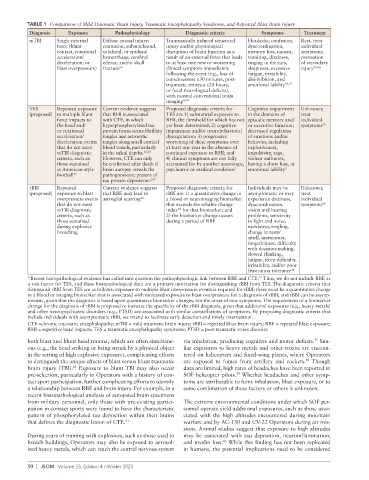
TABLE 1  Comparison of Mild Traumatic Brain Injury, Traumatic Encephalopathy Syndrome, and Repeated Blast Brain Injury
           Diagnosis   Exposure        Pathophysiology        Diagnostic criteria      Symptoms     Treatment
           mTBI     Single external   Diffuse axonal injury;   Traumatically induced structural   Headache, confusion,   Rest, treat
                    force (blunt   contusion; subarachnoid,   injury and/or physiological   dyscoordination,   individual
                    contact, rotational   subdural, or epidural   disruption of brain function as a   memory loss, nausea,   symptoms,
                    acceleration/  hemorrhage; cerebral   result of an external force that leads  vomiting, dizziness,   prevention
                    deceleration, or   edema; and/or skull   to at least one new or worsening   ringing in the ears,   of secondary
                    blast overpressure)  fracture 93   clinical symptom immediately   sleepiness, excessive   injury 95,96
                                                       following the event (e.g., loss of   fatigue, irritability,
                                                       consciousness ≤30 minutes, post-  disinhibition, and
                                                       traumatic amnesia ≤24 hours,   emotional lability 94,95
                                                       or focal neurological deficits),
                                                       with normal conventional brain
                                                       imaging 4,94
           TES      Repeated exposure  Current evidence suggests   Proposed diagnostic criteria for    Cognitive impairment   Unknown;
           (proposed) to multiple blunt   that RHI is associated   TES are 1) substantial exposure to   in the domains of   treat
                    force impacts to   with CTE, in which   RHI, the threshold for which has not  episodic memory and/  individual
                    the head and/  hyperphosphorylated tau   yet been determined; 2) cognitive   or executive function;   symptoms 96
                    or rotational   protein forms neurofibrillary  impairment and/or neurobehavioral  decreased regulation
                    acceleration/   tangles and astrocytic   dysregulation; 3) progressive   of emotions and/or
                    deceleration events  tangles along small cortical   worsening of these symptoms over   behavior, including
                    that do not meet   blood vessels, particularly   at least one year in the absence of   explosiveness,
                    mTBI diagnostic   in the sulcal depths. 32,33    continued exposure to RHI; and   impulsivity, rage,
                    criteria, such as   However, CTE can only   4) clinical symptoms are not fully   violent outbursts,
                    those sustained   be confirmed after death if   accounted for by another neurologic,  having a short fuse, or
                    in American-style   brain autopsy reveals the   psychiatric or medical condition    emotional lability
                                                                              5
                                                                                              5
                    football*      pathognomonic pattern of
                                   tau protein deposition. 5,97
           rBBI     Repeated       Current evidence suggests   Proposed diagnostic criteria for    Individuals may be   Unknown;
           (proposed) exposure to blast   that RBE may lead to   rBBI are 1) a quantitative change in   asymptomatic or may   treat
                    overpressure events  astroglial scarring 26  a blood or neuroimaging biomarker  experience dizziness,   individual
                    that do not meet                   that exceeds the reliable change   dyscoordination,  symptoms 96
                    mTBI diagnostic                    index  for that biomarker; and    vision and hearing
                                                           87
                    criteria, such as                  2) the biomarker change occurs   problems, sensitivity
                    those sustained                    during a period of RBE     to light and noise,
                    during explosive                                              numbness, tingling,
                    breaching                                                     change in taste/
                                                                                  smell, inattention,
                                                                                  forgetfulness, difficulty
                                                                                  with decision-making,
                                                                                  slowed thinking,
                                                                                  fatigue, sleep difficulty,
                                                                                  irritability, and/or poor
                                                                                  frustration tolerance 36
          *Recent histopathological evidence has called into question the pathophysiologic link between RBE and CTE.  Thus, we do not include RBE as
                                                                                      31
          a risk factor for TES, and these histopathological data are a primary motivation for distinguishing rBBI from TES. The diagnostic criteria that
          distinguish rBBI from TES are as follows: exposure to multiple blast overpressure events is required for rBBI; there must be a quantitative change
          in a blood or imaging biomarker that is associated with increased exposure to blast overpressure for a diagnosis of rBBI; and rBBI can be asymp-
          tomatic, given that the diagnosis is based upon quantitative biomarker changes, not the onset of new symptoms. The requirement of a biomarker
          change for the diagnosis of rBBI is proposed to increase the specificity of the rBBI diagnosis, given that additional exposures (e.g., heavy metals)
          and other neuropsychiatric disorders (e.g., PTSD) are associated with similar constellations of symptoms. By proposing diagnostic criteria that
          include individuals with asymptomatic rBBI, we intend to facilitate early detection and timely intervention.
          CTE =chronic traumatic encephalopathy; mTBI = mild traumatic brain injury; rBBI = repeated blast brain injury; RBE = repeated blast exposure;
          RHI = repetitive head impacts; TES = traumatic encephalopathy syndrome; PTSD = post-traumatic stress disorder.

          both blast and blunt head trauma, which are often simultane-  via inhalation, producing cognitive and motor deficits.  Sim-
                                                                                                        57
          ous (e.g., the head striking or being struck by a physical object   ilar exposures to heavy metals and other toxins are encoun-
          in the setting of high explosive exposure), complicating efforts   tered on helicopters and fixed-wing planes, where Operators
                                                                                                     58
          to distinguish the unique effects of blast versus blunt traumatic   are exposed to fumes from artillery and rockets.  Though
          brain injury (TBI).  Exposure to blunt TBI may also occur   data are limited, high rates of headaches have been reported in
                         23
                                                                              59
          pre-selection, particularly in Operators with a history of con-  SOF helicopter pilots.  Whether headaches and other symp-
          tact sport participation, further complicating efforts to identify   toms are attributable to fume inhalation, blast exposure, or to
          a relationship between RBE and brain injury. For example, in a   some combination of these factors or others is unknown.
          recent histopathological analysis of autopsied brain specimens
          from military personnel, only those with pre-existing partici-  The extreme environmental conditions under which SOF per-
          pation in contact sports were found to have the characteristic   sonnel operate yield additional exposures, such as those asso-
          pattern of phosphorylated tau deposition within their brains   ciated with the high altitudes encountered during mountain
          that defines the diagnostic lesion of CTE. 31      warfare and by AC-130 and CV-22 Operators during air mis-
                                                             sions. Animal studies suggest that exposure to high altitudes
          During years of training with explosives, such as those used to   may be associated with tau deposition, neuroinflammation,
          breach buildings, Operators may also be exposed to aerosol-  and myelin loss.  While this finding has not been replicated
                                                                          60
          ized heavy metals, which can reach the central nervous system   in humans, the potential implications need to be considered
          50  |  JSOM   Volume 23, Edition 4 / Winter 2023

