


Page 33 - JSOM Winter 2023
P. 33
Effects of Tourniquet Features on
                                             Application Processes Times


                                 Piper Wall, DVM, PhD *; Charisse Buising, PhD ; Alex White ;
                                                                                            3
                                                       1
                                                                               2
                                                               5
                                             4
                              JaNiese Jensen ; Justin Davis, MD ; Catherine Hackett Renner, PhD 6


              ABSTRACT
              Background: We investigated emergency-use limb tourniquet   arterially occlusive, secure applications and the speed of achiev-
              design features effects on application processes (companion   ing tourniquet-sustainable arterial occlusion. Using  scoring
              paper) and times to complete those processes (this paper).   and time, we investigated the effects  of different tourniquet
              Methods: Sixty-four appliers watched training videos then   design features on appliers’ ability to correctly and quickly ap-
              each applied all eight tourniquets: Combat Application Tour-  ply emergency-use limb tourniquets. The hypothesis was that
              niquet Generation 7  (CAT7), SOF  Tactical Tourniquet-Wide   different features would have different effects on the successes
                                         ®
                             ®
              Generation  3  (SOFTTW3),  SOF   Tactical  Tourniquet-Wide   and times of application processes. This paper discusses the
                                        ®
              Generation 5 (SOFTTW5), Tactical Mechanical Tourniquet    times for application processes. The companion paper earlier
                                                             ™
              (TMT), OMNA Marine  Tourniquet  (OMT), X8T-Tourni-  in this journal discussed the success of application processes. 1
                                           ®
              quet (X8T),  Tactical Ratcheting Medical  Tourniquet  (Tac
                                                        ®
              RMT), and RapidStop  Tourniquet  (RST). Application  pro-  Methods
                                ™
              cesses times were captured from videos. Results: From “Go”
              to “touch tightening system” was fastest with clips and self-   The Drake University Institutional Review Board approved
              securing redirect buckles and without strap/redirect applica-  this study. The companion paper  details all the methods ex-
                                                                                          1
              tion process problems (n, median seconds: CAT7 n=23, 26.89;   cept  those  for  application  timing.  In  brief,  eight  tourniquet
              SOFTTW3 n=11, 20.95; SOFTTW5 n=16, 20.53; TMT n=5,   designs were applied in randomized order. Tourniquet parts
              26.61; OMT n=12, 25.94; X8T n=3, 18.44; Tac RMT n=15,   and activities were divided into the strap and redirect buckle
              30.59; RST n=7, 22.80). From “touch tightening system” to   (“strap/redirect system”) and the tightening system. Major
              “last occlusion” was fastest with windlass rod systems when   design feature differences among tourniquets are shown and
              there were no tightening system understanding or mechanical     described in Figure 1 and Table 1 of the companion paper.  The
                                                                                                             1
              problems (seconds: CAT7 n=48, 4.21; SOFTTW3 n=47, 5.99;   major design feature differences were the presence or absence
              SOFTTW5 n=44, 4.65; TMT n=38, 6.21; OMT n=51, 6.22;   of a strap/redirect system clip (no clip: CAT7, OMT, Tac RMT;
              X8T n=48, 7.59; Tac RMT n=52, 8.44; RST n=40, 8.02). For   clip: SOFTTW3, SOFTTW5, TMT, X8T, RST), whether or not
              occluded, tightening system secure applications, from “touch   strap/redirect systems were self-securing (strap/redirect not
              tightening system” to “Done” was fastest with self-securing   self-securing: CAT7, TMT, OMT; strap/redirect self- securing:
              tightening systems tightening from a tight strap (occluded, se-  SOFTTW3, SOFTTW5, X8T, Tac RMT, RST), whether or not
              cure time in seconds from a tight strap: CAT7 n=17, 14.47;   tightening systems were self-securing (tightening system not
              SOFTTW3 n=22, 10.91; SOFTTW5 n=38, 9.19; TMT n=14,   self-securing: CAT7, SOFTTW3, SOFTTW5,  TMT; tighten-
              11.42;  OMT  n=44, 7.01;  X8T  n=12  9.82; Tac  RMT  n=20,   ing system self-securing: OMT, X8T, Tac RMT, RST) and the
              6.45; RST n=23, 8.64). Conclusions: Suboptimal processes in-  plane of rotation of the tightening system (parallel to the limb:
              crease application times. Optimal design features for fast, oc-  CAT7, SOFTTW3, SOFTTW5, TMT, X8T; perpendicular to
              clusive, secure tourniquet applications are self-securing strap/  the limb: OMT, Tac RMT, RST).
              redirect systems with an easily identified and easily used clip
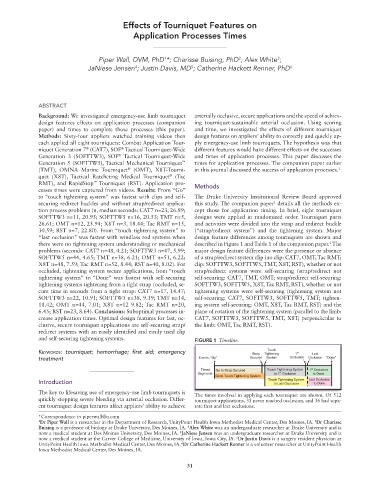
              and self-securing tightening systems.              FIGURE 1  Timeline.

                                                                                        Touch
              Keywords: tourniquet; hemorrhage; first aid; emergency               Strap  Tightening  1 st  Last
              treatment                                           Events: "Go"     Secured  System  Occlusion  Occlusion  "Done"
                                                                   Timed  Go to Strap Secured  Touch Tightening System  1  Occlusion
                                                                                                       st
                                                                  Segments:                to 1  Occlusion  to Done
                                                                                            st
                                                                       Go to Touch Tightening System
              Introduction                                                               Touch Tightening System  Last Occlusion
                                                                                                       to Done
                                                                                          to Last Occlusion
              The key to lifesaving use of emergency-use limb tourniquets is   The times involved in applying each tourniquet are shown. Of 512
              quickly stopping severe bleeding via arterial occlusion. Differ-  tourniquet applications, 35 never reached occlusion, and 36 had sepa-
              ent tourniquet design features affect appliers’ ability to achieve     rate first and last occlusions.
              *Correspondence to piperwall@q.com
                                                                                                        2
              1 Dr Piper Wall is a researcher in the Department of Research, UnityPoint Health Iowa Methodist Medical Center, Des Moines, IA.  Dr Charisse
              Buising is a professor of biology at Drake University, Des Moines, IA.  Alex White was an undergraduate researcher at Drake University and is
                                                              3
              now a medical student at Des Moines University, Des Moines, IA.  JaNiese Jensen was an undergraduate researcher at Drake University and is
                                                            4
                                                                              5
              now a medical student at the Carver College of Medicine, University of Iowa, Iowa City, IA.  Dr Justin Davis is a surgery resident physician at
                                                             6
              UnityPoint Health Iowa Methodist Medical Center, Des Moines, IA. Dr Catherine Hackett Renner is a volunteer researcher at UnityPoint Health
              Iowa Methodist Medical Center, Des Moines, IA.
                                                              31

