


Page 118 - JSOM Winter 2023
P. 118
fluid mechanics perspective to identify the operating temperature   respectively. Moreover, two attendees collapsed during the train-
          envelope of the kit for a safe blood transfusion. An experimental   ing and another two participants reported a mental breakdown
          apparatus is designed for generating a controlled flow through   due to a flashback (former engagement) and “overwhelming real-
          the transfusion kit and tested in an environmental chamber with   ism.” None of the providers had to attend a psychiatrist afterward.
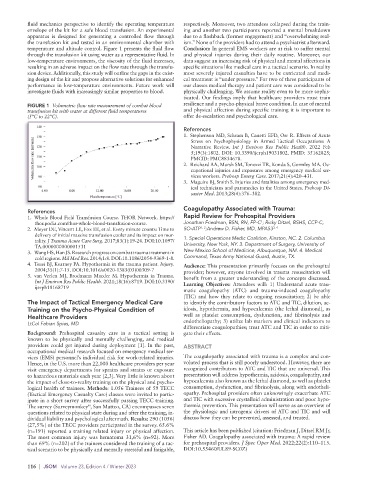
          temperature and altitude control. Figure 1 presents the fluid flow   Conclusion: In general EMS workers are at risk to suffer mental
          through the transfusion kit using water as a representative fluid. In   and physical injuries during their daily routine. Moreover, our
          low-temperature environments, the viscosity of the fluid increases,   data suggest an increasing risk of physical and mental affections in
          resulting in an adverse impact on the flow rate through the transfu-  specific situations like medical care in a tactical scenario. In reality
          sion device. Additionally, this study will outline the gaps in the exist-  most severely injured casualties have to be extricated and medi-
          ing design of the kit and propose alternative solutions for enhanced   cal treatment is “under pressure.” For two of three participants of
          performance in low-temperature environments. Future work will   our classes medical therapy and patient care was considered to be
          investigate fluids with increasingly similar properties to blood.  physically challenging. We assume reality even to be more sophis-
                                                             ticated. Our findings imply that healthcare providers must train
          FIGURE 1  Volumetric flow rate measurement of combat blood   resilience and a psycho-physical brave condition. In case of mental
          transfusion kit with water at different fluid temperatures    and physical affection during specific training it is important to
          (5°C to 22°C).                                     offer de-escalation and psychological care.

                                                             References
                                                             1.  Stephenson MD, Schram B, Canetti EFD, Orr R. Effects of Acute
                                                               Stress on Psychophysiology in  Armed  Tactical Occupations:  A
                                                               Narrative Review.  Int J Environ Res Public Health. 2022 Feb
                                                               5;19(3):1802. DOI: 10.3390/ijerph19031802. PMID: 35162825;
                                                               PMCID: PMC8834678.
                                                             2.  Reichard AA, Marsh SM, Tonozzi TR, Konda S, Gormley MA. Oc-
                                                               cupational injuries and exposures among emergency medical ser-
                                                               vices workers. Prehosp Emerg Care. 2017;21(4):420–431.
                                                             3.  Maguire BJ, Smith S. Injuries and fatalities among emergency med-
                                                               ical technicians and paramedics in the United States. Prehosp Di-
                                                               saster Med. 2013;28(4):376–382.

                                                             Coagulopathy Associated with Trauma:
          References
          1.  Whole Blood Field Transfusion Course. THOR Network. https://  Rapid Review for Prehospital Providers
                                                                                      1
            thor.podia.com/thor-whole-blood-transfusion-course.  Jonathan Friedman, BSN, RN, FP-C ; Ricky Ditzel, BSHS, CCP-C,
                                                                   1, 2
          2.  Meyer DE, Vincent LE, Fox EE, et al. Every minute counts: Time to   SO-ATP ;Andrew D. Fisher, MD, MPAS3 3, 4
            delivery of initial massive transfusion cooler and its impact on mor-
            tality. J Trauma Acute Care Surg. 2017;83(1):19-24. DOI:10.1097/  1. Special Operations Medic Coalition, Kinston, NC. 2. Columbia
            TA.0000000000001531                              University, New York, NY. 3. Department of Surgery, University of
          3.  Wang HS, Han JS. Research progress on combat trauma treatment in   New Mexico School of Medicine, Albuquerque, NM. 4. Medical
            cold regions. Mil Med Res. 2014;1:8. DOI:10.1186/2054-9369-1-8.  Command, Texas Army National Guard, Austin, TX.
          4.  Tsuei BJ, Kearney PA. Hypothermia in the trauma patient. Injury.   Audience: This presentation primarily focuses on the prehospital
            2004;35(1):7-15. DOI:10.1016/s0020-1383(03)00309-7  provider; however, anyone involved in trauma resuscitation will
          5.  van Veelen MJ, Brodmann Maeder M. Hypothermia in Trauma.   benefit from a greater understanding of the concepts discussed.
            Int J Environ Res Public Health. 2021;18(16):8719. DOI:10.3390/  Learning Objectives:  Attendees will: 1) Understand acute trau-
            ijerph18168719
                                                             matic  coagulopathy  (ATC)  and  trauma-induced  coagulopathy
                                                             (TIC) and how they  relate  to ongoing resuscitation;  2) be  able
          The Impact of Tactical Emergency Medical Care      to identify the contributory factors to ATC and TIC, dilution, ac-
          Training on the Psycho-Physical Condition of       idosis, hypothermia, and hypocalcemia (the lethal diamond), as
          Healthcare Providers                               well as platelet consumption, dysfunction, and fibrinolysis and
          LtCol Fabian Spies, MD                             endotheliopathy; 3) utilize lab markers and clinical indicators to
                                                             differentiate coagulopathies; treat ATC and TIC in order to miti-
          Background: Prehospital casualty care in a tactical setting is   gate their effects.
          known to be physically and mentally challenging, and medical
          providers could get injured during deployment [1]. In the past,   ABSTRACT
          occupational medical research focused on emergency medical ser-
          vices (EMS) personnel’s individual risk for work-related injuries.   The coagulopathy associated with trauma is a complex and con-
          Hence, in the U.S. more than 22,000 healthcare providers per year   voluted process that is still poorly understood. However, there are
          visit emergency departments for sprains and strains or exposure   recognized contributors to ATC and TIC that are universal. This
          to hazardous materials each year [2,3]. Very little is known about   presentation will address hypothermia, acidosis, coagulopathy, and
          the impact of close-to-reality training on the physical and psycho-  hypocalcemia also known as the lethal diamond, as well as platelet
          logical health of trainees. Methods: 1.056 Trainees of 59 TECC   consumption, dysfunction, and fibrinolysis, along with endotheli-
          (Tactical Emergency Casualty Care) classes were invited to partic-  opathy. Prehospital providers often unknowingly exacerbate ATC
          ipate in a short survey after successfully passing TECC training.   and TIC with excessive crystalloid administration and poor hypo-
          The survey (Surveymonkey , San Matteo, CA) encompasses seven   thermia prevention. This presentation will serve as an overview of
                              ®
          questions related to physical state during and after the training, in-  the physiologic and iatrogenic drivers of ATC and TIC and will
          dividual liability and psychological aftermath. Results: 290 (1056)   discuss how they can be prevented, assessed, and treated.
          (27,5%) of the TECC providers participated in the survey. 65.6%
          (n=191) reported a training related injury or physical affection.   This article has been published (citation: Friedman J, Ditzel RM Jr,
          The most common injury was hematoma 31,6% (n=92). More   Fisher AD. Coagulopathy associated with trauma: A rapid review
          than 69% (n=202) of the trainees considered the training of a tac-  for prehospital providers. J Spec Oper Med. 2022;22(2):110–115.
          tical scenario to be physically and mentally stressful and fatigable,   DOI:10.55460/UL89-SC0Z)

          116  |  JSOM   Volume 23, Edition 4 / Winter 2023

