


Page 43 - JSOM Spring 2023
P. 43
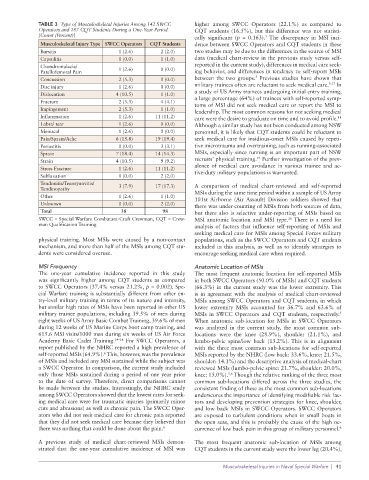
TABLE 3  Type of Musculoskeletal Injuries Among 142 SWCC   higher among SWCC Operators (22.1%) as compared to
              Operators and 187 CQT Students During a One-Year Period    CQT students (16.5%), but this difference was not statisti-
              [Count (Percent)]                                  cally  significant  (p  =  0.163).  The  discrepancy  in  MSI  inci-
                                                                                        5
              Musculoskeletal Injury Type SWCC Operators  CQT Students  dence between SWCC Operators and CQT students in these
              Bursitis                  1 (2.6)       2 (2.0)    two studies may be due to the differences in the source of MSI
              Capsulitis                0 (0.0)       1 (1.0)    data (medical chart-review in the previous study versus self-
              Chondromalacia/           1 (2.6)       0 (0.0)    reported in the current study), differences in medical care seek-
              Patellofemoral Pain                                ing behavior, and differences in tendency to self-report MSIs
                                                                                    5
              Concussion                2 (5.3)       0 (0.0)    between the two groups.  Previous studies have shown that
                                                                                                            9,17
              Disc injury               1 (2.6)       0 (0.0)    military trainees often are reluctant to seek medical care.   In
              Dislocation              4 (10.5)       1 (1.0)    a study of US Army trainees undergoing initial entry training,
                                                                 a large percentage (64%) of trainees with self-reported symp-
              Fracture                  2 (5.3)       4 (4.1)    toms of MSI did not seek medical care or report the MSI to
              Impingement               2 (5.3)       1 (1.0)    leadership. The most common reasons for not seeking medical
              Inflammation              1 (2.6)     11 (11.2)    care were the desire to graduate on time and to avoid profile.
                                                                                                               18
              Labral tear               1 (2.6)       0 (0.0)    Although a similar study has not been conducted among NSW
              Meniscal                  1 (2.6)       0 (0.0)    personnel, it is likely that CQT students could be reluctant to
              Pain/Spasm/Ache          6 (15.8)     19 (19.4)    seek medical care for insidious-onset MSIs caused by repeti-
              Periostitis               0 (0.0)       3 (3.1)    tive microtrauma and overtraining, such as running- associated
              Sprain                   7 (18.4)     14 (14.3)    MSIs, especially since running is an important part of NSW
                                                                                     19
              Strain                   4 (10.5)       9 (9.2)    recruits’ physical training.  Further investigation of the prev-
              Stress Fracture           1 (2.6)     11 (11.2)    alence of medical care avoidance in various trainee and ac-
                                                                 tive-duty military populations is warranted.
              Subluxation               0 (0.0)       2 (2.0)
              Tendonitis/Tenosynovitis/                          A  comparison  of  medical  chart-reviewed  and  self-reported
              Tendinopathy              3 (7.9)     17 (17.3)    MSIs during the same time period within a sample of US Army
              Other                     1 (2.6)       1 (1.0)    101st  Airborne (Air  Assault) Division soldiers showed that
              Unknown                   0 (0.0)       2 (2.0)    there was under-counting of MSIs from both sources of data,
              Total                      38           98         but there also is selective under-reporting of MSIs based on
              SWCC = Special Warfare Combatant-Craft Crewman, CQT = Crew-  MSI anatomic location and MSI type.  There is a need for
                                                                                               20
              man Qualification Training                         analysis of factors that influence self-reporting of MSIs and
                                                                 seeking medical care for MSIs among Special Forces military
              physical training. Most MSIs were caused by a non-contact   populations, such as the SWCC Operators and CQT students
              mechanism, and more than half of the MSIs among CQT stu-  included in this analysis, as well as to identify strategies to
              dents were considered overuse.                     encourage seeking medical care when required.

              MSI Frequency                                      Anatomic Location of MSIs
              The one-year  cumulative incidence reported in this study   The most frequent anatomic location for self-reported MSIs
              was significantly higher among CQT students as compared   in both SWCC Operators (50.0% of MSIs) and CQT students
              to SWCC Operators (37.4% versus 21.2%, p = 0.002). Spe-  (66.3%) in the current study was the lower extremity. This
              cial Warfare training is substantially different from other en-  is in agreement with the analysis of medical chart-reviewed
              try-level military training in terms of its nature and intensity,   MSIs among SWCC Operators and CQT students, in which
              but similar high rates of MSIs have been reported in other US   lower extremity MSIs accounted for 36.7% and 63.6% of
              military trainee populations, including 39.5% of men during   MSIs  in  SWCC Operators  and CQT  students, respectively.
                                                                                                                5
              eight weeks of US Army Basic Combat Training, 39.6% of men   When anatomic sub-location for MSIs in SWCC Operators
              during 12 weeks of US Marine Corps boot camp training, and   was analyzed in the current study, the most common sub-
              615.6 MSI visits/1000 men during six weeks of US Air Force   locations were the knee (28.9%), shoulder (21.1%), and
              Academy Basic Cadet Training. 14–16  For SWCC Operators, a   lumbo-pelvic spine/low back (13.2%).  This is in alignment
              report published by the NHRC reported a high prevalence of   with the three most common sub-locations for self-reported
              self-reported MSIs (64.9%).  This, however, was the prevalence   MSIs reported by the NHRC (low back: 33.6%, knee: 21.5%,
                                   6
              of MSIs and included any MSI sustained while the subject was   shoulder: 14.1%) and the descriptive analysis of medical-chart
              a SWCC Operator. In comparison, the current study included   reviewed MSIs ( lumbo-pelvic spine: 21.7%, shoulder: 20.0%,
              only those MSIs sustained during a period of one year prior   knee: 15.0%).  Though the relative ranking of the three most
                                                                            5,6
              to the date of survey.  Therefore, direct comparisons cannot   common sub- locations differed across the three studies, the
              be made between the studies. Interestingly, the NHRC study   consistent finding of these as the most common sub-locations
              among SWCC Operators showed that the lowest rates for seek-  underscores the importance of identifying modifiable risk fac-
              ing medical care were for traumatic injuries (primarily minor   tors and developing prevention strategies for knee, shoulder,
              cuts and abrasions) as well as chronic pain. The SWCC Oper-  and low back MSIs in SWCC Operators. SWCC Operators
              ators who did not seek medical care for chronic pain reported   are exposed to turbulent conditions when in small boats in
              that they did not seek medical care because they believed that   the open seas, and this is probably the cause of the high oc-
              there was nothing that could be done about the pain. 6  currence of low back pain in this group of military personnel. 6
              A previous study of medical chart-reviewed MSIs demon-  The most frequent anatomic sub-location of MSIs among
              strated that the one-year cumulative incidence of MSI was   CQT students in the current study were the lower leg (20.4%),

                                                                          Musculoskeletal Injuries in Naval Special Warfare  |  41

