


Page 35 - JSOM Spring 2023
P. 35
type was not reported. Hardy et al. studied 1,267 US Army   TABLE 2  Cricothyroidotomy Results Summary
              medical evacuation patients from Operation Enduring Free-                    No. interventions
                                  13
              dom from 2011 to 2014.  Nearly half of patients (617) re-  Study  Provider type  (% of total)  Success
              quired some form of airway intervention, although only four   Adams et al.   Total  17 (100%)  76.4%
              were managed with endotracheal intubation (one performed   2008  Unknown        6 (35.3%)
              by a medic and three performed by paramedics). Success rates
              and number of attempts was not reported. Gerhardt et al. ex-   Medic            4 (23.5%)
              amined 318 casualties from a forward operating base in cen-    Physician        4 (23.5%)
                                   14
              tral Iraq from 2004 to 2005.  Ten intubations were performed   PA               2 (11.8%)
              (3.1%), all by a physician or PA. Maddry and Bebarta studied   Nurse anesthetist  1 (5.9%)
              prehospital airway interventions of 1,022 patients transported   Barnard et al.   Total  34 (100%)  82.40%
                                                            15
              to US military facilities in Afghanistan from 2011 to 2014.    2014  Helicopter medic  18 (52.9%)
              Twenty-two prehospital intubations were conducted (2.2%).      Unknown         10 (29.4%)
              Finally, Murad et al. studied 2,788 Iraqi trauma patients from   Ground Medic   6 (17.6%)
              1997 to 2006, all treated by local national paramedics.  The   Blackburn et al.  Total  16 (100%)  —
                                                         16
              injuries were from landmines, war injuries and traffic colli-  2018  Physician    8 (50%)
              sions. Nineteen intubations were performed (0.7%).
                                                                             Medic              8 (50%)
                                                                 Gerhardt et al.   Total       4 (100%)     —
              Cricothyroidotomy                                  2011        Physician/PA       3 (75%)
              Seventeen studies reported on prehospital combat cricothyroi-  Medic              1 (25%)
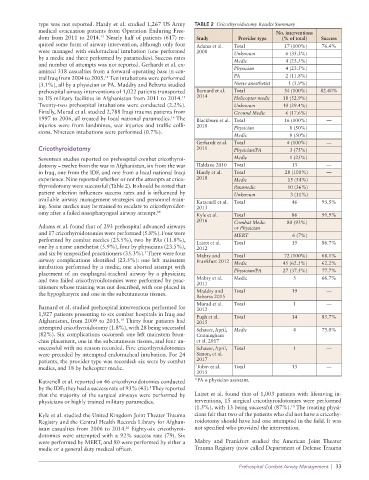
              dotomy – twelve from the war in Afghanistan, six from the war   Haldane 2010  Total  13       —
              in Iraq, one from the IDF, and one from a local national Iraqi   Hardy et al.   Total  28 (100%)  —
              experience. Nine reported whether or not the attempts at crico-  2018  Medic     15 (54%)
              thyroidotomy were successful (Table 2). It should be noted that   Paramedic      10 (36%)
              patient selection influences success rates and is influenced by   Unknown         3 (11%)
              available airway management strategies and personnel train-  Katzenell et al.   Total  46   93.5%
              ing. Some medics may be trained to escalate to cricothyroidot-  2013
              omy after a failed nasopharyngeal airway attempt. 18  Kyle et al.    Total        86        91.9%
                                                                 2016        Combat Medic      80 (93%)
              Adams et al. found that of 293 prehospital advanced airways    or Physician
              and 17 cricothyroidotomies were performed (5.8%). Four were    MERT                6 (7%)
              performed by combat medics (23.5%), two by PAs (11.8%),   Lairet et al.   Total   15        86.7%
              one by a nurse anesthetist (5.9%), four by physicians (23.5%),   2012
              and six by unspecified practitioners (35.3%).  There were four   Mabry and   Total  72 (100%)  68.1%
                                                7
              airway complications identified (23.5%): one left mainstem   Frankfurt 2012  Medic  45 (62.5%)  62.2%
              intubation performed by a medic; one aborted attempt with
              placement of an esophageal-tracheal airway by a physician;     Physician/PA    27 (37.5%)   77.7%
              and two failed cricothyroidotomies were performed by prac-  Mabry et al.   Medic   3        66.7%
              titioners whose training was not described, with one placed in   2011
              the hypopharynx and one in the subcutaneous tissues.  Maddry and   Total          19          —
                                                                 Bebarta 2015
                                                                 Murad et al.   Total            1          —
              Barnard et al. studied prehospital interventions performed for   2012
              1,927 patients presenting to six combat hospitals in Iraq and   Pugh et al.   Total  14     85.7%
                                        19
              Afghanistan, from 2009 to 2013.  Thirty four patients had   2015
              attempted cricothyroidotomy (1.8%), with 28 being successful   Schauer, April,   Medic  4   75.0%
              (82%). Six complications occurred: one left mainstem bron-  Cunningham
              chus placement, one in the subcutaneous tissues, and four un-  et al. 2017
              successful with no reason recorded. Five cricothyroidotomies   Schauer, April,   Total  1     —
              were preceded by attempted endotracheal intubation. For 24   Simon, et al.
              patients, the provider type was recorded: six were by combat   2017
              medics, and 18 by helicopter medic.                Tobin et al.   Total           13          —
                                                                 2015
              Katzenell et al. reported on 46 cricothyroidotomies conducted   *PA = physician assistant.
                                                  1
              by the IDF; they had a success rate of 93% (43). They reported
              that the majority of the surgical airways were performed by   Lairet et al. found that of 1,003 patients with lifesaving in-
              physicians or highly trained military paramedics.  terventions, 15 surgical cricothyroidotomies were performed
                                                                                                10
                                                                 (1.5%), with 13 being successful (87%).  The treating physi-
              Kyle et al. studied the United Kingdom Joint Theater Trauma   cians felt that two of the patients who did not have a cricothy-
              Registry and the Central Health Records Library for Afghan-  roidotomy should have had one attempted in the field. It was
              istan casualties from 2006 to 2014.  Eighty-six cricothyroi-  not specified who provided the intervention.
                                          20
              dotomies were attempted with a 92% success rate (79). Six
              were performed by MERT, and 80 were performed by either a   Mabry and Frankfurt studied the  American Joint  Theater
              medic or a general duty medical officer.           Trauma Registry (now called Department of Defense Trauma

                                                                               Prehospital Combat Airway Management  |  33

