


Page 3 - JSOM Fall 2022
P. 3
from the
PUBLISHER
Michelle DuGuay Landers, MBA, BSN, RN
Lt Col (Ret)
Greetings JSOM Subscribers, TABLE 1 Medications Recommended in the TCCC Pain and Analgesia Guidelines Contraindications Side Effects
Medication
Action(s)
Dose(s)
Acetaminophen Two 500mg tablets Antipyretic, analgesic via Liver failure patients, unable No major side effects
(Paracetamol, Tylenol) (1000mg total) by mouth unknown mechanism to tolerate PO medication,
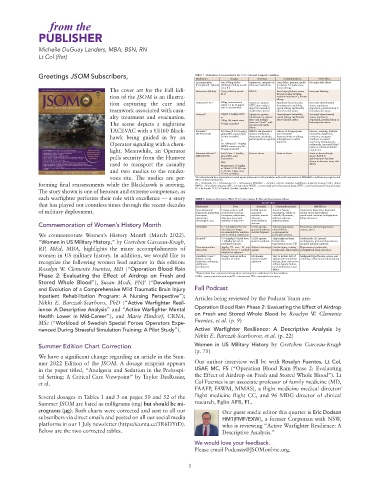
The cover art for the Fall Edi Meloxicam (Mobic) every 8 h NSAID known allergy Increased bleeding
Renal injury/failure, severe
15mg tablet by mouth
24 h life-threatening bleeding,
tion of the JSOM is an illustra unable to tolerate PO, known
allergy
tion capturing the care and Fentanyl OTFC* 800μg transmucosal, Opiate mu-agonist, Significant facial wounds, Increased altered mental
repeat × 1 in 15 min if
hemodynamic instability,
OTFC dose made to
status, respiratory
teamwork associated with casu pain is uncontrolled drop from casualty’s opioid allergy, significantly depression, potential drop in
hemodynamic status
mouth when altered
altered mental status
alty treatment and evacuation. Fentanyl* 50μg (0.5–1μg/kg) IV/IO Opiate mu-agonist, Hemodynamic instability, Increased altered mental
redistributes in adipose
opioid allergy, significantly
status, respiratory
or
100μg IN; repeat every tissue and multiple altered mental status depression, potential drop in
hemodynamic status
The scene depicts a night time
doses can “stack” with
Michelle D. Landers, Lt Col (Ret) 30 min as needed increased effect/side
effects
TACEVAC with a UH60 Black Ketamine* 20–30mg (0.2–0.3mg/kg) NMDA and glutamate History of laryngospasm, Nausea, vomiting, diplopia,
(ANALGESIA) slow IV/IO, repeat every receptor antagonist, prior ketamine drowsiness, dysphoria,
hawk being guided in by an 20 min as needed dissociative anesthetic, hypersensitivity or allergy, confusion, emergence
reactions, increased
partial opiate mu agonist schizophrenia or active
or
Operator signaling with a chem 50–100mg (0.5–1mg/kg) psychosis secretions, laryngospasm,
tachycardia, increased blood
IM/IN, repeat every 20–
pressure, enhanced skeletal
light. Meanwhile, an Operator 30 min, as needed muscle tone
Ketamine Infusion* Initial dose: 1–2mg/kg Same as above Same as above Same as above, though
pulls security from the Humvee (SEDATION) slow IV/IO until slower RATE of
dissociation
administration has been
used to transport the casualty then shown to decrease many side
effects
Maintenance: 0.3mg/kg
and two medics to the rendez in 100mL 0.9% NS over
5–15 min, repeat every
45 min as needed
vous site. The medics are per *Providers should have appropriate reversal agents (naloxone for all opioids) as well as all components of MSMAID to address any negative side
effects of these medications.
forming final reassessments while the Blackhawk is arriving. IN = intranasal; IO = intraosseous; IV = intravenous; MSMAID = monitor, suction, machine [ventilatory support], airway, IV/IO, drugs;
NMDA = N-methyl-d-aspartate; NS = normal saline; NSAID = nonsteroidal anti-inflammatory drug; OTFC = oral transmucosal fentanyl citrate;
PO = by mouth; TCCC = Tactical Combat Casualty Care.
The story shown is one of heroism and extreme competence, as
each warfighter performs their role with excellence — a story TABLE 3 Sedation Alternatives When TCCC Care Cannot Be Met and Environment Allows
SEDATIVES
that has played out countless times through the recent decades Medication Dose Action(s) Contraindication(s) Side-Effects
of military deployment. Benzodiazepine* Dosage varies as well GABA agonist: Renal or hepatic Respiratory depression, depressed
mental status, hypotension,
(diazepam, midazolam, as duration of action;
anxiolytic,
impairment, elderly or
lorazepam, lorazepam, midazolam, sedative, muscle critically ill patients, paradoxical reactions, tachyphylaxis
alprazolam, diazepam most used relaxant, delirious patients, (drug tolerance)
clonazepam, etc.) sedatives in drip form anticonvulsant, substance abuse
Commemoration of Women’s History Month Etomidate 0.1–0.3mg/kg IV for one amnesic Adrenal suppression, Myoclonus, adrenal suppression,
GABA agonist,
time dose; no longer general anesthetic, critical illness, nausea, apnea
We commemorate Women’s History Month (March 2022). recommended for sedation sedative hypnotic requirement for
prolonged sedation
due to adrenal suppression
“Women in US Military History,” by Gretchen Garceau-Kragh, Propofol* 0.5–2mg/kg IV initial dose; GABA agonist, Hypertriglyceridemia, Bradycardia, QT interval
general anesthetic
5–60μg/kg per min in
bradycardia,
prolongation, profound hypotension,
hypotension, severe TBI
prolonged sedation
propofol infusion syndrome
RP, MEd, MBA, highlights the many accomplishments of Dexmedetomidine 1μg /kg IV over 10 min Alpha-2 adrenergic Cardiac injury, existing Hypotension, bradycardia,
followed by 0.2–1.5μg /kg/h agonist
bradycardia, hypotension tachyphylaxis (drug tolerance),
(Precedex)
women in US military history. In addition, we would like to Anesthetic Gases* infusion for sedation Mechanism Vary to include lack of Malignant hyperthermia, nausea and
Dosage varies as well as
recognize the following women lead authors in this edition: (nitrous oxide, duration of action remains mostly appropriate monitoring vomiting, carbon monoxide poisoning
unknown
halothane, isoflurane,
devices, those with severe
asthma, hepatic failure,
desflurane,
sevoflurane) renal dysfunction, heart
Roselyn W. Clemente Fuentes, MD (“Operation Blood Rain failure
*Patients must have a protected airway when receiving these medications for deep sedation.
Phase 2: Evaluating the Effect of Airdrop on Fresh and GABA = gamma-aminobutyric acid; IV = intravenous; TBI = traumatic brain injury.
Stored Whole Blood”), Susan Modi, FNP (“Development
and Evolution of a Comprehensive Mild Traumatic Brain Injury Fall Podcast
Inpatient Rehabilitation Program: A Nursing Perspective”); Articles being reviewed by the Podcast Team are:
Nikki E. Barczak-Scarboro, PhD (“Active Warfighter Resil-
ience: A Descriptive Analysis” and “Active Warfighter Mental Operation Blood Rain Phase 2: Evaluating the Effect of Airdrop
Health Lower in Mid-Career”), and Marie Hindorf, CRNA, on Fresh and Stored Whole Blood by Roselyn W. Clemente
MSc (“Workload of Swedish Special Forces Operators Expe- Fuentes, et al. (p. 9)
rienced During Stressful Simulation Training: A Pilot Study”). Active Warfighter Resilience: A Descriptive Analysis by
Nikki E. Barczak-Scarborov, et al. (p. 22)
Women in US Military History by Gretchen Garceau-Kragh
Summer Edition Chart Correction
(p. 75)
We have a significant change regarding an article in the Sum
mer 2022 Edition of the JSOM. A dosage misprint appears Our author interview will be with Roselyn Fuentes, Lt Col,
in the paper titled, “Analgesia and Sedation in the Prehospi USAF, MC, FS (“Operation Blood Rain Phase 2: Evaluating
tal Setting: A Critical Care Viewpoint” by Taylor DesRosier, the Effect of Airdrop on Fresh and Stored Whole Blood”). Lt
et al. Col Fuentes is an associate professor of family medicine (MD,
FAAFP, FAWM, MMAS), a flight medicine medical director/
Several dosages in Tables 1 and 3 on pages 50 and 52 of the flight medicine flight CC, and 96 MDG director of clinical
Summer JSOM are listed as milligrams (mg) but should be mi- research, Eglin AFB, FL.
crograms (µg). Both charts were corrected and sent to all our Our guest medic editor this quarter is Eric Dodson
subscribers via direct emails and posted on all our social media HM1(FMF/EXW), a former Corpsman with NSW,
platforms in our 1 July newsletter (https://conta.cc/3R6DYtD). who is reviewing “Active Warfighter Resilience: A
Below are the two corrected tables. Descriptive Analysis.”
We would love your feedback.
Please email Podcasts@JSOMonline.org.
1

