


Page 38 - JSOM Summer 2020
P. 38
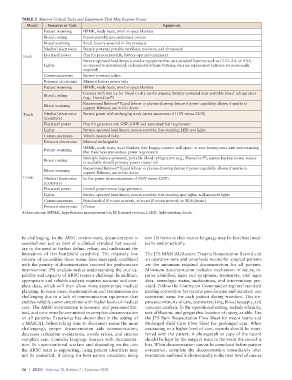
TABLE 3  Mission Critical Tasks and Equipment That May Require Power
            Model    Function or Task                               Equipment
                   Patient warming  HPMK, ready heats, wool or space blankets
                   Blood cooling   Person-portable preconditioned coolers
                   Blood warming   Small, battery-powered in-line products
                   Medical electronics   Battery-powered portable ventilator, monitors, and ultrasound
           Ruck    Electrical power  Plan for person-portable, battery-operated equipment
                                   Battery-operated head lamps (consider equipment that uses standard batteries such as C123, AA, or AAA,
                   Lights          as opposed to nonstandard, rechargeable lithium batteries, because replacement batteries are more easily
                                   acquired)
                   Communications  Battery-powered radios
                   Personal electronics  Minimal battery power only
                   Patient warming   HPMK, ready heats, wool or space blankets
                                   Coolers with wet ice for blood or dry ice for plasma; battery-powered man-portable blood refrigerators
                   Blood cooling
                                   (e.g., HemaCool )
                                               ®
                                   Recommend Belmont  Rapid Infuser or plasma-thawing devices if power capability allows; if unable to
                                                  ®
                   Blood warming
                                   support Belmont, use in-line device
           Truck   Medical electronics   Battery power with recharging cords (stress awareness of 110V versus 220V)
                   (monitors)
                   Electrical power  Plan for generator size 5kW–20kW and associated fuel requirement
                   Lights          Battery-operated head lamps; person-portable, free-standing, LED spot lights
                   Communications  Vehicle-mounted radio
                   Personal electronics  Minimal rechargeable
                                   HPMK, ready heats, wool blankets, Bair hugger, consider wall space- or area-heating units with understanding
                   Patient warming
                                   that these have tremendous power requirement
                                   Multiple battery-powered, portable blood refrigerators (e.g., HemaCool ), ensure backup power source
                                                                                     ®
                   Blood cooling   is available should primary power source fail
                                   Recommend Belmont  Rapid Infuser or plasma-thawing devices if power capability allows; if unable to
                                                  ®
                   Blood warming
                                   support Belmont, use in-line device
           House   Medical electronics   In-line power (stress awareness of 110V versus 220V)
                   (monitors)
                   Electrical power  Central power versus large generator
                   Lights          Battery-operated head lamps; person-portable, free-standing spot lights; wall-mounted lights
                   Communications  Nonclassified IP router network, or secret IP router network or WiFi (choice)
                   Personal electronics  Choice
          Abbreviations: HPMK, hypothermia management kit; IP, Internet protocol; LED, light-emitting diode.


          be challenging. In the ARSC environment, documentation is   non US forms in their native language may be beneficial med-
          essential not just as part of a clinical standard but second-  ically and practically.
          ary to the need to further define, refine, and understand the
          limitations of this battlefield capability. The relatively low   The JTS MASCAL/Austere Trauma Resuscitation Record and
          volume of causalities these teams have managed, combined   an operative note and anesthesia record for surgical patients
          with the paucity of documentation received for performance   are the minimum required documentation for all patients.
          improvement (PI) analysis makes understanding the true ca-  Minimum documentation  includes mechanism  of injury, in-
          pability and capacity of ARSC teams a challenge. In addition,   juries identified, signs and symptoms, treatments, vital signs
          appropriate and reliable analysis requires accurate and com-  data, neurologic status, medications, and interventions pro-
          plete data, which will then allow more appropriate medical   vided. Follow the Combatant Command or regional standard
          planning. In some cases, documentation and transmission are   naming convention for trauma pseudonyms and maintain one
          challenging due to a lack of communication equipment that   consistent  name  for  each  patient  during  transfers.  This  im-
          enables reliable communications with higher levels of medical   proves continuity of care, patient tracking, blood resupply, and
          care. The ARSC environment is resource and personnel lim-  outcome analysis. In the operational setting, include ethnicity,
          ited, and time must be committed to complete documentation   unit affiliation, and geographic location of injury, as able. Use
          on all patients. Experience has shown that in the setting of   the JTS Burn Resuscitation Flow Sheet for major burns and
          a MASCAL (when taking time to document seems the most   Prolonged Field Care Flow Sheet for prolonged care. When
          challenging), proper documentation aids communication,   evacuating to a higher level of care, records should be trans-
          decreases redundant evaluations, avoids errors, and ensures   ferred with the patient. A photograph or copy of the record
          complete care. Consider language barriers with documenta-  should be kept by the surgical team in the event the record is
          tion. In unconventional warfare and depending on the unit   lost. When documentation cannot be completed before patient
          the ARSC team is supporting, using patient identifiers may   evacuation,  complete the  documentation immediately  after
          not be permitted. If caring for host-nation casualties, using   evacuation and send it electronically to the next level of care as


          36  |  JSOM   Volume 20, Edition 2 / Summer 2020

