


Page 66 - JSOM Winter 2019
P. 66
of injury. Therefore, tranexamic acid should be given as soon   providers must consider pausing at the end of the initial inter-
          as possible.  This effect was also demonstrated in a military   ventions to manage hemorrhagic shock to consider whether
                   25
          setting in the Military Application of Tranexamic Acid in   there may be other causes for the shock state, particularly if
          Trauma Emergency Resuscitation study. 26           the patient has failed to respond to any of the aforementioned
          R – Retain heat                                    interventions. Cognitive psychology suggests that such use of
            •  Achieve and maintain normothermia.            slower, System 2 thinking further reduces the risk of error in
          The detrimental effects of hypothermia and hyperthermia on   such settings. 32
          coagulation and, hence, death have been clearly demonstrated
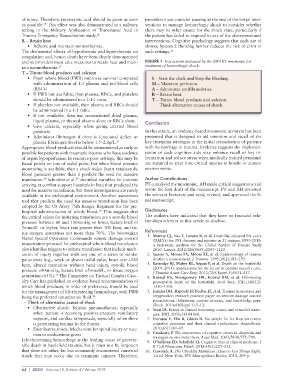
          and so providers must take measures to retain heat and main-  FIGURE 1  Key actions indicated by the SMART mnemonic for
          tain normothermia. 27                              treatment of hemorrhagic shock.
          T – Titrate blood products and calcium
            •  Fresh whole blood (FWB) improves survival compared
               with administration of 1:1 plasma and red blood cells
               (RBCs)
            •  If FWB not available, then plasma, RBCs, and platelets
               should be administered in a 1:1:1 ratio.
            •  If platelets not available, then plasma and RBCs should
               be administered in a 1:1 ratio.
            •  If not available, then use reconstituted dried plasma,
               liquid plasma, or thawed plasma alone or RBCs alone.  Conclusion
            •  Give calcium, especially when giving citrated blood
               products.                                     In this article, an evidence-based mnemonic acronym has been
            •  Administer fibrinogen if there is functional deficit or   presented that is designed to aid retention and recall of the
               plasma fibrinogen level is below 1.5–2.0g/L. 21  key treatment strategies in the initial resuscitation of patients
          Appropriate blood products should be administered as early as   with hemorrhage in trauma. Evidence suggests the implemen-
          possible for patients with traumatic injuries who have evidence   tation of such cognitive aids may enhance recall of key in-
          of organ hypoperfusion. In resource-poor settings, this may be   formation and reduce stress when medically trained personnel
          based purely on loss of radial pulse, but when blood pressure   are required to treat time-critical injuries in hostile or austere
          monitoring is available, then a shock index (heart rate/systolic   environments.
          blood pressure) greater than 1 predicts the need for massive
          transfusion.  Schreiber et al.  identified variables for patients   Author Contributions
                                29
                   28
          arriving at combat support hospitals in Iraq that predicted the   PT conceived the mnemonic. AH made critical suggestions and
          need for massive transfusion, but these investigations are rarely   wrote the first draft of the manuscript. PT and AH reviewed
          available in the prehospital environment. Another assessment   the relevant literature and read, revised, and approved the fi-
          tool that predicts the need for massive transfusion has been   nal manuscript.
          adopted by the US Army 75th Ranger Regiment for the pre-
          hospital administration of whole blood.  This suggests that   Disclosures
                                          30
          the critical values for initiating transfusion are a systolic blood   The authors have indicated that they have no financial rela-
          pressure between 80 and 100mmHg or lower, lactate level of   tionships relevant to this article to disclose.
          5mmol/L or higher, heart rate greater than 100 bpm, and tis-
          sue  oxygen  saturation  not  more  than  70%.  The  Norwegian   References
          Naval Special Operation Commando remote damage control   1.  Murray CJ, Vos T, Lozano R, et al. Disability-adjusted life years
                                                                (DALYs) for 291 diseases and injuries in 21 regions, 1990-2010:
          resuscitation protocol for prehospital whole-blood transfusion   a systematic analysis for the Global Burden of Disease Study
          also identifies triggers to initiate transfusion that include mech-  2010. Lancet. 2012;380(9859):2197–1223.
          anism of injury together with any one of a series of similar   2.  Sauaia A, Moore FA, Moore EE, et al. Epidemiology of trauma
          parameters (e.g., weak or absent radial pulse, heart rate >120   deaths: a reassessment. J Trauma. 1995;38(2):185–193.
          bpm, altered mentation without head injury, systolic blood   3.  Eastridge BJ, Mabry RL, Seguin P, et al. Death on the battlefield
          pressure <90mmHg, lactate level >5mmol/L, or tissue oxygen   (2001-2011): implications for the future of combat casualty care.
                                                                J Trauma Acute Care Surg. 2012;73(6 Suppl 5):S431–437.
          saturation<65%).  The Committee on Tactical Combat Casu-  4.  Kotwal RS, Montgomery HR, Kotwal BM, et al. Eliminating
                        31

          alty Care has published an evidence-based recommendation of   preventable death on the battlefield. Arch Surg. 2011;146(12):
          which blood products, in order of preference, should be used   1350–1358.
          for the management of life-threatening hemorrhage, with FWB   5.  Jenkins DH, Rappold JF, Badloe JF, et al. Trauma hemostasis and
          being the preferred resuscitation fluid. 22           oxygenation research position paper on remote damage control
            – Think of alternative causes of shock              resuscitation: definitions, current practice, and knowledge gaps.
                                                                Shock. 2014;41(Suppl 1):3–12.
            •  Obstructive shock: Tension pneumothorax, especially   6.  Scott IA. Errors in clinical reasoning: causes and remedial strate-
               when patient is receiving positive-pressure ventilatory   gies. BMJ. 2009;338:b1860.
               support, and cardiac tamponade, especially when there   7.  Fioratou E, Flin R, Glavin R. No simple fix for fixation errors:
               is penetrating trauma to the thorax              cognitive processes and their clinical applications. Anaesthesia.
            •  Distributive shock: Mechanism for spinal injury or reac-  2010;65(1):61–69.
               tion to medications given                      8.  Croskerry P. The importance of cognitive errors in diagnosis and
          Life-threatening hemorrhage is the leading cause of prevent-  strategies to minimize them. Acad Med. 2003;78(8):775–780.
          able death in battlefield trauma, but it must not be forgotten   9.  O’Sullivan ED, Schofield SJ. Cognitive bias in clinical medicine. J
                                                                R Coll Physicians Edinb. 2018;48(3):225–232.
          that there are other, far less commonly encountered causes of   10.  Gawande A. The Checklist Manifesto : How to Get Things Right.
          shock  that  may  occur  due  to  traumatic  injuries.  Therefore,   1st ed. New York, NY: Metropolitan Books; 2010, 209 p.


          64  |  JSOM   Volume 19, Edition 4 / Winter 2019

