


Page 19 - JSOM Winter 2019
P. 19
revealed a healthy appearing young man with no obvious signs   during and after capture can derive from the environment or
              of trauma. The ANASOC SGN believed the patient appeared   from torture. Malaria, dysentery, cholera, typhoid and para-
              depressed, but the linguists and CJSOTF-A SGN did not ob-  sites are common in captivity,  and studies have demonstrated
                                                                                       11
              serve this finding. This disparity in clinical assessment was   an increased risk of peptic ulcers, purportedly from stress and
              most likely due to unspoken communication and subtle sig-  an increased incidence of H pylori infection.  Imprisonment
                                                                                                    10
              nals and was not due to the language barrier. The CJSOTF-A   often includes physical restraints that can place repetitive con-
              SGN and ANASOC SGN ordered laboratory tests as available   strictive pressure on extremities, and POWs have been found
              at the local clinic. These laboratory tests included urine, com-  to have an increased incidence of long-term peripheral nervous
              plete blood count, basic metabolic panel, malaria screening,   system disorders. Other methods of confinement paired with
              and typhoid screening.                             disruptive articular trauma may contribute to the increased in-
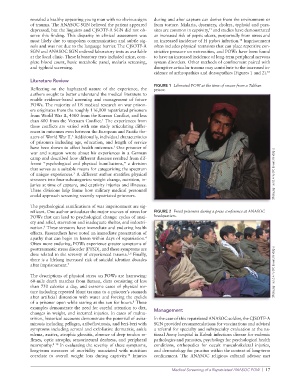
                                                                 cidence of arthropathies and dorsopathies (Figures 1 and 2). 10
              Literature Review
                                                                 FIGURE 1  Liberated POW at the time of rescue from a Taliban
              Reflecting on the haphazard nature of the experience, the   prison.
              authors sought to better understand the medical literature to
              enable evidence-based screening and management of future
              POWs. The majority of US medical research on war prison-
              ers originates from the roughly 116,000 repatriated prisoners
              from World War II, 4500 from the Korean Conflict, and less
              than 600 from the Vietnam Conflict.  The experiences from
                                           1
              these conflicts are varied with one study articulating differ-
              ences in outcomes even between the European and Pacific the-
              aters of World War II.  Additionally, individual characteristics
                               2
              of prisoners including age, education, and length of service
              have been shown to affect health outcomes.  One prisoner of
                                                1
              war and surgeon wrote about his experiences in a German
              camp and described how different diseases resulted from dif-
              ferent “psychological and physical humiliations,” a division
              that serves as a suitable means for categorizing the spectrum
              of unique experiences.  A different author stratifies physical                                      (Photograph by US Army SPC Edward Randolph.)
                               3
              stressors into four subcategories: weight change, nutrition, in-
              juries at time of capture, and captivity injuries and illnesses.
              These divisions help frame how military medical personnel
              could approach screening recently repatriated prisoners.
              The psychological ramifications of war imprisonment are sig-
              nificant. One author articulates the major sources of stress for   FIGURE 2  Freed prisoners during a press conference at ANASOC
              POWs that can lead to psychological change: cycles of anxi-  headquarters.
              ety and relief, starvation and inadequate shelter, and indoctri-
              nation.  These stressors have immediate and enduring health
                   4
              effects. Researchers have noted an immediate presentation of
              apathy that can begin to lessen within days of repatriation.
                                                             4
              Often more enduring, POWs experience greater symptoms of
              posttraumatic stress disorder (PTSD), and these symptoms are
              dose related to the severity of experienced trauma.  Finally,
                                                      5,6
              there is a lifelong increased risk of suicidal ideation decades
              after imprisonment. 7
              The descriptions of physical stress on POWs are harrowing:                                          (Photograph by US Army SPC Edward Randolph.)
              60-mile death marches from Bataan, diets consisting of less
              than 750 calories a day, and extreme cases of physical tor-
              ture including repeated blunt trauma to a prisoner’s stomach
              after artificial distention with water and forcing the eyelids
              of a prisoner open while staring at the sun for hours.  These
                                                        8
              examples demonstrate the need for careful attention to diet,   Management
              changes in weight, and incurred injuries. In cases of malnu-
              trition, historical accounts demonstrate the potential of avita-  In the case of this repatriated ANASOC soldier, the CJSOTF-A
              minosis including pellagra, ariboflavinosis, and beri-beri with   SGN provided recommendations for vaccinations and advised
              symptoms including scrotal and exfoliative dermatitis, ankle   a referral for specialty and subspecialty evaluation at the na-
              edema, ascites, atrophic glossitis, absence of deep tendon re-  tional Army hospital in Kabul: infectious disease for endemic
              flexes, optic atrophy, sensorineural deafness, and peripheral   pathologies and parasites, psychology for psychological health
              neuropathy. 8–10  In evaluating the severity of these symptoms,   conditions, orthopedics for occult musculoskeletal injuries,
              long-term measures of morbidity associated with nutrition   and dermatology for pruritus within the context of long-term
              correlate to overall weight loss during captivity.  Injuries   confinement. The ANASOC religious cultural advisor met
                                                      10
                                                                        Medical Screening of a Repatriated ANASOC POW  |  17

