


Page 6 - JSOM Summer 2019
P. 6
CASE REPORTS                                       Best Tourniquet Holding and Strap Pulling Technique: The
          The case of cutis marmorata in conjunction with neurological   default for best tourniquet strap-application technique is to
          symptoms in a 57-year-old man after aggressive diving is pre-  hold above the buckle and pull the strap tangential to the limb
          sented in Mottled, Blanching Skin Changes After Aggressive   at the buckle. Additionally, neither strength nor experience
          Diving.                                            guarantees desirable strap pressures in the absence of pressure
                                                             knowledge.
          Differential Diagnosis of an Unusual Snakebite Presentation
          in Benin: Dry Bite or Envenomation? highlights an unusual   Resilience and Suicide in Special Operations Forces: State
          case of snakebite with persistent neuropathy despite an appar-  of the Science via Integrative Review: Because of overall in-
          ent lack of envenomation and a number of snakebite-specific   consistency in military resilience research, studies have limited
          variables that complicated the initial assessment, diagnosis,   external validity, and cannot be applied beyond sampled pop-
          and treatment of the patient.                      ulations. Resilience cannot be responsibly offered as a solution
                                                             to mitigating posttraumatic stress disorder nor suicide without
                                                             detailed study of both in SOF. An Editor’s Note follows.
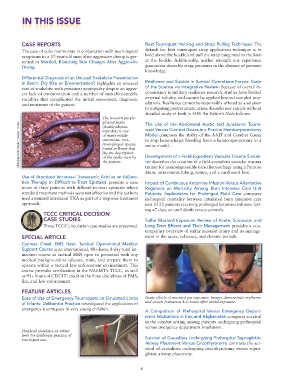
                                           The western purple-  The Use of  the Abdominal Aortic  and Junctional Tourni-
                                           glossed snake
         Photographed by Stephen Spawls in Ghana.  of many mildly   Model compares the ability of the AAJT and Combat Gauze
                                           (Amblyodipsas
                                                             quet Versus Combat Gauze in a Porcine Hemicorporectomy
                                           unicolor) is one
                                                             to stop hemorrhagic bleeding from a hemicorporectomy in a
                                           venomous, non–
                                           front-fanged species
                                                             swine model.
                                           found in Benin that
                                           fits the description
                                                             Development of a Field-Expedient Vascular Trauma Simula-
                                           of the snake seen by
                                                             tor describes the creation of a field-expedient vascular trauma
                                           the patient.
                                                             trainer for noncompressible torso hemorrhage using a Penrose
                                                             drain, intravenous tubing, suture, and a cardboard box.
          Use of Atomized Intranasal Tranexamic Acid as an Adjunc-
          tive Therapy in Difficult-to-Treat Epistaxis  presents a case   Impact of Continuous Ketamine Infusion Versus Alternative
          series of three patients with difficult-to-treat epistaxis where   Regimens on Mortality Among Burn Intensive Care Unit
          standard treatment methods were not effective and the authors   Patients: Implications for Prolonged Field Care  compares
          used atomized intranasal TXA as part of a stepwise treatment   in-hospital mortality between intubated burn intensive care
          approach.                                          unit (ICU) patients receiving prolonged ketamine infusion last-
                                                             ing ≥7 days or until death versus controls.
                   TCCC CRITICAL DECISION
                   CASE STUDIES                              Sulfur Mustard Exposure: Review of Acute, Subacute, and
                   Three TCCC circulation case studies are presented.  Long-Term Effects and Their Management provides a con-
                                                             temporary overview of sulfur mustard injury and its manage-
          SPECIAL ARTICLE                                    ment in the acute, subacute, and chronic periods.
          Cypress Creek EMS Basic Tactical Operational Medical
          Support Course is an international, 80+-hour, 8-day total im-
          mersion course in tactical EMS open to personnel with any
          medical  background  to  educate,  train,  and  prepare  them  to
          operate within a tactical law enforcement environment. This
          course provides certification in the NAEMT’s TCCC, as well
          as 91+ hours of CE/CHE credit in the three disciplines of EMS,
          fire, and law enforcement.
          FEATURE ARTICLES
          Ease of Use of Emergency Tourniquets on Simulated Limbs   Acute effects of mustard gas exposure. Images demonstrate erythema
          of Infants: Deliberate Practice investigated the application of   and vesicle formation 4–6 hours after initial exposure.
          emergency tourniquets in very young children.
                                                             A Comparison of Prehospital Versus Emergency Depart-
                                                             ment Intubations in Iraq and Afghanistan compares survival
                                                             in the combat setting among patients undergoing prehospital
                                                             versus emergency department intubation.
          Handrail simulates an infant
          limb for deliberate practice of
          tourniquet use.                                    Survival of Casualties Undergoing Prehospital Supraglottic
                                                             Airway Placement Versus Cricothyrotomy contrasts the sur-
                                                             vival of causalities undergoing cricothyrotomy versus supra-
                                                             glottic airway placement.


                                                           4

