


Page 86 - JSOM Winter 2018
P. 86
JMP Pro, version 9.3 (SAS Institute, www.sas.com), using a χ    those who had no military service (OR, 2.7; 95% CI, 1.6–4.6;
                                                         2
          test with measures of association for a 2 × 2 table. Associations   p < .001).
          between demographics of interest and willingness to respond
          under certain conditions were determined using the Fisher ex-  Willingness to respond using ballistic gear and no firearm was
          act test (JMP Pro), with p < .01 indicating significance.  also associated with having tactical or military training, with
                                                             98.6% (n = 136 of 138) of those with training indicating they
                                                             would respond, compared with 88.4% (n = 222 of 251) of
          Results
                                                             those without training (OR, 8.9; 95% CI, 2.1–37.8; p < .001).
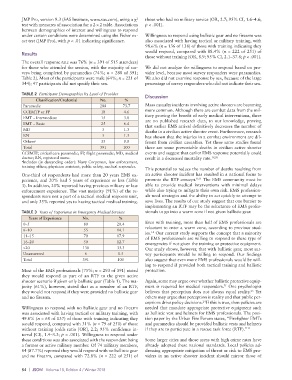
          The overall response rate was 76% (n = 391 of 515 attendees)
          for those who attended the session, with the majority of sur-  We did not analyze the willingness to respond based on pro-
          veys being completed by paramedics (74%; n = 288 of 391;   vider level, because most survey responders were paramedics.
          Table 2). Most of the participants were male (64%; n = 221 of   We also did not examine response by sex, because of the large
          344); 47 participants did not specify their sex.   percentage of survey responders who did not indicate their sex.

          TABLE 2  Participant Demographics by Level of Provider  Discussion
                Classification/Credential  No.      %
           Paramedic                      288       73.7     Mass casualty incidents involving active shooters are becoming
           CCEMTP or FP                    18       4.6      more common. Although there are combat data from the mil-
                                                             itary proving the benefit of early medical interventions, there
           EMT – Intermediate              15       3.8      are  no  published  research  data,  to  our  knowledge,  proving
           EMT – Basic                     25       6.4      that earlier EMS arrival definitively decreases the number of
           MD                              5        1.3      deaths in a civilian active shooter event. Furthermore, research
           RN                              5        1.3      has shown that the injuries in a combat environment are dif-
           Others a                        35       9.0      ferent from civilian casualties. Yet these same studies found
           Total                          391       100      there are some  preventable deaths in civilian active shooter
          CCEMTP, critical care paramedic; FP, flight paramedic; MD, medical   events and suggest that earlier EMS response potentially could
          doctor; RN, registered nurse.                      result in a decreased mortality rate. 19,20
          a Includes (in descending order): Navy Corpsman, law enforcement,
          training officer, physician assistant, public safety, medical responder.
                                                             This potential to reduce the number of deaths resulting from
          One-third of respondents had more than 20 years EMS ex-  an active shooter incident has resulted in a national focus to
          perience, and 20% had 5 years of experience or less (Table   promote the RTF concept. 8,11  The EMS community must be
          3). In addition, 20% reported having previous military or law   able to provide medical interventions with minimal delays
          enforcement experience. The vast majority (91%) of the re-  while also trying to mitigate their own risk. EMS profession-
          spondents were not a part of a tactical medical response unit,   als need strategies and the ability to act quickly to attempt to
          and only 35% reported yes to having tactical medical training.  save lives. The results of our study suggest that one barrier to
                                                             implementing an RTF may be the reluctance of EMS profes-
          TABLE 3  Years of Experience in Emergency Medical Services  sionals to go into a warm zone if not given ballistic gear.
             Years of Experience   No.            %
           0–5                      80           20.4        Even with training, more than half of EMS professionals are
                                                             reluctant to enter a warm zone, according to previous stud-
           6–10                     55           14.1        ies.  Our current study supports the concept that a minority
                                                                12
           11–15                    70           17.9        of EMS professionals are willing to respond to these type of
           16–20                    50           12.7        emergencies if not given the training or protective equipment.
           >20                     130           33.3        Our study shows, however, that with ballistic gear, most sur-
           Unanswered               6             1.5        vey  participants  would  be  willing  to  respond.  Our  findings
           Total                   391            100        also suggest that even more EMS professionals would be will-
                                                             ing to respond if provided both tactical training and ballistic
          Most of the EMS professionals (75%; n = 293 of 391) stated   protection.
          they would respond as part of an RTF to the given active
          shooter scenario if given only ballistic gear (Table 1). The ma-  Again, some may argue over whether ballistic protective equip-
                                                                                             21
          jority (61%), however, stated that as a member of an RTF,   ment is required for medical responders.  One psychologist
                                                                                                         23
          they would not respond if they were provided no ballistic gear   believes that perception does not always equal reality.  Yet
          and no firearm.                                    others may argue that perception is reality and that public per-
                                                             ceptions drive policy decisions. If this is true, then policies are
                                                                                     24
          Willingness to respond with no ballistic gear and no firearm   needed that mandate appropriate protective equipment such
          was associated with having tactical or military training, with   as ballistic vest and helmets for EMS professionals. The posi-
          49.6% (n = 68 of 137) of those with training indicating they   tion paper by the Urban Fire Forum states, “Firefighter EMTs
          would respond, compared with 31% (n = 79 of 250) of those   and paramedics should be provided ballistic vests and helmets
          without training (odds ratio [OR], 2.2; 95% confidence in-  if they are to participate in a rescue task force (RTF).” 11
          terval [CI], 1.4–3.3; p < .001). Willingness to respond under
          these conditions was also associated with the respondent being   Some larger cities and those areas with high crime rates have
          a former or active military member. Of 74 military members,   already adopted these national standards. Local policies ad-
          64 (87.7%) reported they would respond with no ballistic gear   dressing appropriate mitigation of threat or risk to EMS pro-
          and no firearm, compared with 72.8% (n = 222 of 251) of   viders  in an  active  shooter  incident  should mirror  those  of


          84  |  JSOM   Volume 18, Edition 4 / Winter 2018

