


Page 106 - JSOM Winter 2018
P. 106
stress response.  A study of cancer patients with anxiety found   the efficacy of the treatment (P = .78). Posttreatment, both
                      9
          that “patients experienced a significant decrease in pain inten-  males and females reported a decrease on the pain scale. For
          sity and anxiety” compared with the control group. 10,11  Studies   males, the self-reported median posttreatment pain score was
          like these have helped to build objective evidence supporting   3 (IQR 1.5–4.5) and the median posttreatment pain score for
          the use of reflexology in chronic pain patients. There is a lack   females was 3 (IQR 2–4). This represents a 43% (IQR 25%–
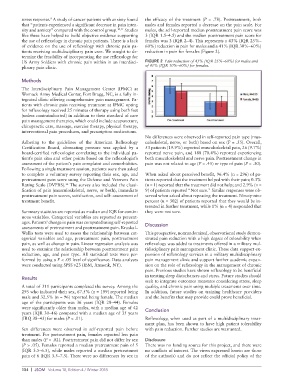
          of evidence on the use of reflexology with chronic pain pa-  60%) reduction in pain for males and a 41% (IQR 30%–60%)
          tients receiving multidisciplinary pain care. We sought to de-  reduction in pain for females (Figure 2).
          termine the feasibility of incorporating the use reflexology for
          US Army Soldiers with chronic pain within in an interdisci-  FIGURE 2  Pain reduction of 43% (IQR 25%–60%) for males and
          plinary pain clinic.                               of 41% (IQR 30%–60%) for females.

          Methods
          The  Interdisciplinary  Pain  Management  Center  (IPMC)  at
          Womack Army Medical Center, Fort Bragg, NC, is a fully in-
          tegrated clinic offering comprehensive pain management. Pa-
          tients with chronic pain receiving treatment at IPMC opting
          for reflexology received 25 minutes of therapy using both feet
          (unless contraindicated) in addition to their standard of care
          pain management therapies, which could include acupuncture,
          chiropractic care, massage, exercise therapy, physical therapy,
          interventional pain procedures, and prescription medications.
                                                             No differences were observed in self-reported pain type (mus-
          Adhering to the guidelines of the American Reflexology   culoskeletal, nerve, or both) based on sex (P = .55). Overall,
          Certification Board, alternating pressure was applied by a   53 patients (19.9%) reported musculoskeletal pain, 26 (9.7%)
          board-certified reflexologist correlating to the individual pa-  reported nerve pain, and 188 (70.4%) reported experiencing
          tient’s pain sites and other points based on the reflexologist’s   both musculoskeletal and nerve pain. Posttreatment change in
          assessment of the patient’s pain complaint and comorbidities.   pain was not related to age (P = .45) or type of pain (P = .30).
          Following a single treatment session, patients were then asked
          to complete a voluntary survey reporting their sex, age, and   When asked about perceived benefit, 96.4% (n = 296) of pa-
          pretreatment pain score using the Defense and Veterans Pain   tients reported that the treatment helped with their pain; 0.3%
          Rating Scale (DVPRS).  The survey also included the classi-  (n = 1) reported that the treatment did not help; and 2.9% (n =
                            12
          fication of pain (musculoskeletal, nerve, or both), immediate   9) of patients reported “Not sure.” Similar responses were ob-
          posttreatment pain scores, satisfaction, and self- assessment of   served when asked about repeating the treatment. Ninety-nine
          treatment benefit.                                 percent (n = 302) of patients reported that they would be in-
                                                             terested in further treatment, while 1% (n = 4) responded that
          Summary statistics are reported as median and IQR for contin-  they were not sure.
          uous variables. Categorical variables are reported as percent-
          ages. Patients’ change in pain was computed using self-reported   Discussion
          assessments of pretreatment and posttreatment pain. Kruskal–
          Wallis tests were used to assess the relationship between cat-  This prospective, nonrandomized, observational study demon-
          egorical variables and age, pretreatment pain, posttreatment   strated pain reduction with a high degree of tolerability when
          pain, as well as change in pain. Linear regression analysis was   reflexology was added to treatments offered in a military mul-
          used to examine the relationship between posttreatment pain   tidisciplinary pain management clinic. These data support ex-
          reduction, age, and pain type. All statistical tests were per-  pansion of reflexology services in a military multidisciplinary
          formed by using a P < .05 level of significance. Data analyses   pain management clinic and support further academic expan-
          were conducted using SPSS v23 (IBM, Armonk, NY).   sion on the role of reflexology in the management of chronic
                                                             pain. Previous studies have shown reflexology to be beneficial
                                                             in treating sleep disturbances and stress. Future studies should
          Results
                                                             seek to integrate outcomes measures considering stress, sleep
          A total of 311 participants completed the survey. Among the   quality, and chronic pain using multiple treatments over time.
          295 who indicated their sex, 67.5% (n = 199) reported being   In  addition, future  studies  on training  healthcare  providers
          male and 32.5% (n = 96) reported being female. The median   and the benefits that may provide could prove beneficial.
          age of the participants was 36 years (IQR 28–44). Females
          were significantly older than males, with a median age of 42   Conclusion
          years (IQR 30–46) compared with a median age of 35 years
          (IRQ 38–43) for males (P < .01).                   Reflexology, when used as part of a multidisciplinary treat-
                                                             ment plan, has been shown to have high patient tolerability
          Sex differences were observed in self-reported pain before   with pain reduction. Further studies are warranted.
          treatment. For pretreatment pain, females reported less pain
          than males (P = .02). Posttreatment pain did not differ by sex   Disclosure
          (P > .05). Females reported a median pretreatment pain of 5   There was no funding source for this project, and there were
          (IQR 3.5–6.5), while males reported a median pretreatment   no conflicts of interest. The views expressed herein are those
          pain of 6 (IQR 3.5–7.5). There were no differences by sex in   of the author(s) and do not reflect the official policy of the


          104  |  JSOM   Volume 18, Edition 4 / Winter 2018

