


Page 47 - JSOM Summer 2018
P. 47
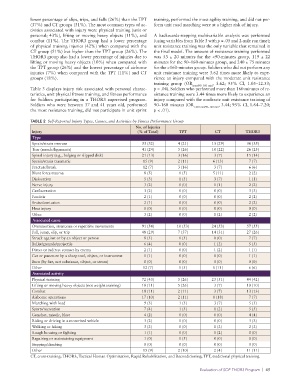
lower percentage of slips, trips, and falls (26%) than the TPT   training, performed the most agility training, and did not per-
              (37%) and CT groups (31%). The most common types of ac-  form unit road marching were at a higher risk of injury.
              tivities associated with injury were physical training (unit or
              personal; 43%), lifting or moving heavy objects (11%), and   A backwards-stepping multivariable analysis was performed
              combat (11%). The THOR3 group had a lower percentage   (using variables from Table 3 with p ≤ .05 and 2-mile run time);
              of physical training injuries (42%) when compared with the   unit resistance training was the only variable that remained in
              CT group (51%) but higher than the TPT group (26%). The   the final model. The amount of resistance training performed
              THOR3 group also had a lower percentage of injuries due to   was 53 ± 20 minutes for the <90-minutes group, 119 ± 22
              lifting or moving heavy objects (10%) when compared with   minutes for the 90–160-minutes group, and 240 ± 75 minutes
              the TPT group (26%) and the lowest percentage of airborne   for the >160-minutes group. Soldiers who did not perform any
              injuries (7%) when compared with the TPT (11%) and CT   unit resistance training were 3.62 times more likely to expe-
              groups (18%).                                      rience an injury compared with the moderate unit resistance
                                                                 training group (OR none/90–160 min , 3.62; 95% CI, 1.05–12.53;
              Table 3 displays injury risk associated with personal charac-  p = .04). Soldiers who performed more than 160 minutes of re-
              teristics, unit physical fitness training, and fitness performance   sistance training were 3.44 times more likely to experience an
              for Soldiers participating in a THOR3 supervised program.   injury compared with the moderate unit resistance training of
              Soldiers who were between 37 and 41 years old, performed   90–160 minutes (OR >160 min/90–160 min , 3.44; 95% CI, 1.64–7.20;
              the most resistance training, did not participate in unit sprint   p < .01).

              TABLE 2  Self-Reported Injury Types, Causes, and Activities by Fitness Performance Group
                                                         No. of Injuries
              Injury                                      (% of Total)     TPT            CT           THOR3
              Type
              Sprain/strain overuse                         53 (32)       4 (21)        13 (29)        36 (35)
              Tear (muscle/ligaments)                       41 (24)       5 (26)        10 (22)        26 (25)
              Spinal injury (e.g., bulging or slipped disk)  21 (13)      3 (16)         3 (7)         15 (14)
              Sprain/strain traumatic                       15 (9)        2 (11)         6 (13)         7 (7)
              Fracture/break                                12 (7)        3 (16)         3 (7)          6 (6)
              Blunt force trauma                            8 (5)          1 (5)         5 (11)         2 (2)
              Dislocation                                   5 (3)          1 (5)         3 (7)          1 (1)
              Nerve injury                                  3 (2)          0 (0)         1 (1)          2 (2)
              Cut/laceration                                3 (2)          0 (0)         0 (0)          3 (3)
              Fasciitis                                     2 (1)          0 (0)         0 (0)          2 (2)
              Bruise/contusion                              2 (1)          0 (0)         0 (0)          2 (2)
              Heat injury                                   0 (0)          0 (0)         0 (0)          0 (0)
              Other                                         3 (2)          0 (0)         1 (2)          2 (2)
              Associated cause
              Overexertion, strenuous or repetitive movements  91 (54)    10 (53)       24 (53)        57 (55)
              Fall, jump, slip, or trip                     48 (29)       7 (37)        14 (31)        27 (26)
              Struck against or by an object or person      8 (5)          1 (5)         0 (0)          7 (7)
              Bullet/grenade/projectile                     6 (4)          0 (0)         1 (2)          5 (5)
              Direct or indirect contact by enemy           2 (1)          0 (0)         1 (2)          1 (1)
              Cut or puncture by a sharp tool, object, or instrument  1 (1)  0 (0)       0 (0)          1 (1)
              Burn (by fire, not substance, object, or steam)  0 (0)       0 (0)         0 (0)          0 (0)
              Other                                         12 (7)         1 (5)         5 (11)         6 (6)
              Associated activity
              Physical training                             72 (43)       5 (26)        23 (51)        44 (42)
              Lifting or moving heavy objects (not weight training)  18 (11)  5 (26)     3 (7)         10 (10)
              Combat                                        18 (11)       2 (11)         3 (7)         13 (13)
              Airborne operations                           17 (10)       2 (11)         8 (18)         7 (7)
              Marching with load                             9 (5)         1 (5)         3 (7)          5 (5)
              Sports/recreation                              7 (4)         1 (5)         1 (2)          5 (5)
              Gunshot, missile, blast                       4 (2)          0 (0)         0 (0)          4 (4)
              Riding or driving in a motorized vehicle      3 (2)          0 (0)         0 (0)          3 (3)
              Walking or hiking                             3 (2)          0 (0)         1 (2)          2 (2)
              Rough housing or fighting                     1 (1)          0 (0)         1 (2)          0 (0)
              Repairing or maintaining equipment            1 (0)          1 (5)         0 (0)          0 (0)
              Stepping/climbing                             0 (0)          0 (0)         0 (0)          0 (0)
              Other                                         15 (9)        2 (10)         2 (4)         11 (11)
              CT, cross-training; THOR3, Tactical Human Optimization, Rapid Rehabilitation, and Reconditioning; TPT, traditional physical training.

                                                                                   Evaluation of SOF THOR3 Program  |  45

