


Page 113 - JSOM Summer 2018
P. 113
Qualified evidence-based recommendations in favor of par-  and/or ease pain.  Claims made on the product label (and in
                                                                              4
              ticular dietary ingredients were made when the evidence sup-  advertising) often draw us in to purchase the product, and
              porting such use outweighed evidence against the use. The   sometimes we find ourselves doing this without reading the
              recommendations were “qualified” because in many cases the   Supplement Facts panel showing what ingredients are in the
              quality of the evidence was not high (i.e., moderate to low   product. As the dietary supplement market continues to grow
              quality). For these ingredients, healthcare providers should be   at a rapid pace, it is important to know what to look for on
              aware of the evidence and prepared to help SOF Operators   and how to read the product label in an objective manner.
              make decisions. Importantly, Operators should consult their
              healthcare provider before taking any dietary supplement for   Are claims made on product labels regulated?
              pain and learn how to select a product that conforms to rig-  The US Food and Drug Administration (FDA) regulations
              orous quality standards, such bearing as a USP or NSF cer-  allow dietary supplements manufacturers to make claims
              tified/verified product seal. No recommendations were made   about health, nutrient content, and statements of nutritional
              when the evidence reviewed was too speculative or tradeoffs   support, often referred to as structure/function claims (e.g.,
              (risk:benefits) were closely balanced to decide on the direction   calcium builds strong bones) related to the ingredients in
              of a recommendation. Conversely, recommendations against   products. Because statements of nutritional support are not
              the current use of ingredients were made when (1) the evidence   approved by the FDA, product labels containing such claims
              for a beneficial effect was lacking, (2) the evidence was sim-  must also include a disclaimer that reads, “This statement
              ply insufficient, or (3) the undesirable anticipated effects out-  has not been evaluated by the FDA. This product is not in-
              weighed the desirable effects, across factors specifically related   tended to diagnose, treat, cure, or prevent any disease.” If
              to SOF. Overall, the panel made no strong recommendations   at any time a manufacturer intends to use a supplement to
              across any of the ingredients claimed to combat pain and op-  treat a condition (such as pain), it must go through the In-
              timize performance, primarily due to the lack of high-quality   vestigational New Drug application process. Because dietary
              evidence.  This finding emphasizes and reinforces the critical   supplements are regulated as foods, unlike drug products, di-
                     3
              importance of shared decision-making between Operators and   etary supplement products are not evaluated for their safety
              their healthcare provider.                         or effectiveness before they reach the consumer. However,
                                                                 manufacturers must ensure the ingredients used are safe
              Table 1 displays the dietary ingredients evaluated and the evi-  and that the labeling and claims made are truthful and not
              dence-based recommendations made for SOF. The evidence is   misleading. If the product is deemed to be not safe or not
              based on studies assessing the efficacy of the specific ingredi-  consistent with label regulations, the FDA may remove the
              ents. Importantly, research assessing the effectiveness of com-  product from the marketplace or take other appropriate ac-
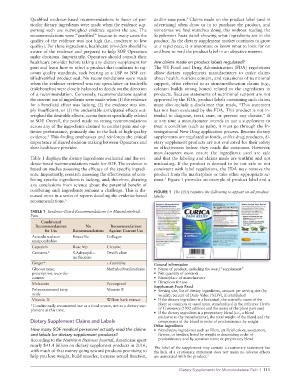
              bining specific ingredients is lacking, and, therefore, drawing   tions.  Figure 1 provides an example of product label and a
                                                                     5
              any conclusions from science about the potential benefit of
              combining such ingredients remains a challenge. This is dis-  FIGURE 1  The FDA requires the following to appear on all product
              cussed more in a series of reports detailing the evidence-based   labels:
              recommendations. 3

              TABLE 1  Evidence-Based Recommendations for Musculoskeletal
              Pain
                  Conditional
                Recommendations     No         Recommendations
                    for Use    Recommendations  Against Current Use
              Avocado soybean   Boswellia    Collagen
              unsaponifiables
              Capsaicin        Rose hip      Creatine
              Curcuma*         S-Adenoysl-l-  Devil’s claw
                               methionine
              Ginger*                        l-Carnitine         General information
              Glucosamine,                   Methylsulfonylmethane  •  Name of product, including the word “supplement”
              prescription, over-the-                            •  Net quantity of contents
              counter                                            •  Name/place of manufacturer
              Melatonin                      Pycnogenol          •  Directions for use
                                                                 Supplement Facts Panel
              Polyunsaturated fatty          Vitamin E           •  Serving size, list of dietary ingredients, amount per serving size (by
              acids                                               weight), percent of Daily Value (%DV), if established
              Vitamin D                      Willow bark extract  •  If the dietary ingredient is a botanical, the scientific name of the
              *Conditionally recommend use as a food source, not as a dietary sup-  plant or common or usual name standardized in the reference Herbs
              plement at this time.                               of Commerce (1992 edition) and the name of the plant part used
                                                                 •  If the dietary ingredient is a proprietary blend (i.e., a blend
                                                                  exclusive to the manufacturer), the total weight of the blend and the
              Dietary Supplement Claims and Labels                components of the blend in order of predominance by weight
                                                                 Other ingredients
              How many SOF medical personnel actually read the claims   •  Nondietary ingredients such as fillers, artificial colors, sweeteners,
              and labels for dietary supplement products?         flavors, or binders; listed by weight in descending order of
              According to the Nutrition Business Journal, Americans spent   predominance and by common name or proprietary blend
              nearly $41.4 billion on dietary supplement products in 2016,   The label of the supplement may contain a cautionary statement but
              with much of that money going toward products promising to   the lack of a cautionary statement does not mean no adverse effects
              help you lose weight, build muscles, increase sexual function,   are associated with the product. 5

                                                                           Dietary Supplements for Musculoskeletal Pain  |  111

