


Page 72 - Journal of Special Operations Medicine - Winter 2016
P. 72
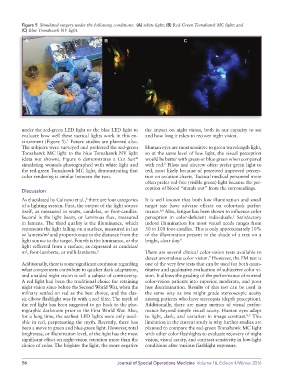
Figure 5  Simulated surgery under the following conditions:  (A) white light; (B) Red-Green Tomahawk MC light; and
          (C) Blue Tomahawk NV light.


            under the red-green LED light or the blue LED light to   the impact on night vision, both in our capacity to see
          evaluate how well these tactical lights work in this en-  and how long it takes to recover night vision.
          vironment (Figure 5).  Future studies are planned also.
                             1
          The subjects were surveyed and preferred the red-green   Human eyes are most sensitive to green wavelength light,
          Tomahawk MC light to the blue Tomahawk NV light    so at the same level of low light, the visual perception
          (data not shown). Figure 6 demonstrates a Cut Suit ®   would be better with green or blue-green when compared
          simulating wounds photographed with white light and   with red.  Pilots and aircrew often prefer green light to
                                                                     2
          the red-green Tomahawk MC light, demonstrating that   red, most likely because of perceived improved percep-
          color rendering is similar between the two.        tion on aviation charts. Tactical medical personnel more
                                                             often prefer red-free (visible green) light because the per-
                                                             ception of blood “stands out” from the surroundings.
          Discussion
          As elucidated by Calvano et al.,  there are four categories   It is well known that both low illumination and small
                                     2
          of a lighting system. First, the output of the light source   target size have adverse effects on color-task perfor-
          itself, as measured in watts, candelas, or foot-candles.   mance.  Also, fatigue has been shown to influence color
                                                                   3,4
          Second is the light beam, or luminous flux, measured   perception in color-deficient individuals.  Satisfactory
                                                                                                 5
          in lumens. The third quality is the illuminance, which   indoor illumination for most visual needs ranges from
          represents the light falling on a surface, measured in lux   50 to 100 foot-candles. This is only approximately 10%
          or lumens/m and proportionate to the distance from the   of the illumination present in the shade of a tree on a
                     2
          light source to the target. Fourth is the luminance, or the   bright, clear day. 6
          light reflected from a surface, as expressed as candelas/
          m , foot-lamberts, or milli-lamberts. 2            There are several clinical color-vision tests available to
            2
                                                             detect anomalous color vision.  However, the FM test is
                                                                                       7
          Additionally, there is some significant confusion regarding   one of the very few tests that can be used for both quan-
          what components contribute to quicker dark adaptation,   titative and qualitative evaluation of subjective color vi-
          and unaided night vision is still a subject of controversy.   sion. It allows the grading of the performance of normal
          A red light had been the traditional choice for retaining   color-vision patients into superior, moderate, and poor
          night vision since before the Second World War, when the   hue discrimination. Results of this test can be used in
          military settled on red as the best choice, and the clas-  the same way as one might grade stereoscopic acuity
          sic elbow flashlight was fit with a red filter. The myth of   among patients who have stereopsis (depth perception).
          the red light has been suggested to go back to the pho-  Additionally, there are many metrics of visual perfor-
          tographic darkroom prior to the First World War. Also,   mance beyond simple visual acuity. Human eyes adapt
          for a long time, the earliest LED lights were only avail-  to light, dark, and variation in image contrast.  This
                                                                                                       8,9
          able in red, perpetuating the myth. Recently, there has   limitation in the current study is why further studies are
          been a move to green and blue-green light. However, total   planned to compare the red-green Tomahawk MC light
          brightness, or illumination level, of the light has the most   with other color flashlights to evaluate recovery of night
          significant effect on night-vision retention more than the   vision, visual acuity, and contrast sensitivity in low-light
          choice of color. The brighter the light, the more negative   conditions after various flashlight exposure.


          56                                     Journal of Special Operations Medicine  Volume 16, Edition 4/Winter 2016

