


Page 82 - Journal of Special Operations Medicine - Summer 2016
P. 82
a result of repetitive training placement. Each device in
                AAJT Design and Testing                      the study was expected to complete 56 tests. All AAJT
                                                             devices tested in the study remained intact for multiple
          by John Croushorn, MD, President, Compression Works  uses before breaking. Therefore, the design as tested
                                                             was shown to be capable of withstanding adverse field
                                                             conditions and maintain a high reliability for   single-
            n the Spring 2016 issue of the  Journal of Special   patient use.
            Operations Medicine, researchers reported results
         Iof a  study of  junctional hemorrhage  and  found the   Irrespective of the study results, Compression Works
          Abdominal Aortic and Junctional Tourniquet (AAJT;   identified a potential weakness within the pressure
          Compression Works; http://compressionworks.com) to   gauge in early 2014 (all devices used in the study were
                         1
          be very effective.  However, they did encounter break-  manufactured  before  this  time).  As  a  preventive  mea-
          age of the pressure gauges on the older devices they were   sure,  a  protective  cap  (i.e.,  shroud)  was  designed  to
          using (Figure 1).
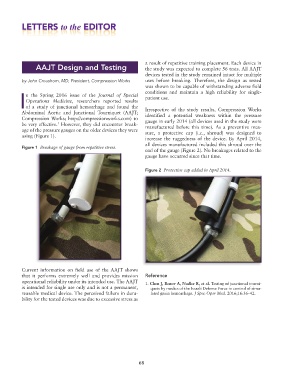
                                                             increase the ruggedness of the device. By April 2014,
                                                             all devices manufactured included this shroud over the
          Figure 1  Breakage of gauge from repetitive stress.
                                                             end of the gauge (Figure 2). No breakages related to the
                                                             gauge have occurred since that time.

                                                             Figure 2  Protective cap added in April 2014.


          Current information on field use of the AAJT shows
          that  it  performs  extremely  well  and  provides  mission   Reference
          operational reliability under its intended use. The AAJT   1. Chen J, Benov A, Nadler R, et al. Testing of junctional tourni-
          is intended for single use only and is not a permanent,   quets by medics of the Israeli Defense Force in control of simu-
          reusable medical device. The perceived failure in dura-  lated groin hemorrhage. J Spec Oper Med. 2016;16:36–42.
          bility for the tested devices was due to excessive stress as


                                                          68

