


Page 106 - Journal of Special Operations Medicine - Spring 2016
P. 106
3
          researchers and healthcare practitioners.  They partici-    responses and running biomechanics. Running in mini-
          pated in a long process that involved identifying and   malist shoes generally resulted in a lower physiological
          discussing the characteristics of shoes of this type. The   energy cost than did running in conventional shoes, in
                                                                        5–8
          definition they  developed for a minimalist  shoe was   most studies.  This is likely because many minimalist
          “footwear providing minimal interference with the nat-  shoes are lighter than conventional shoes. During run-
          ural movement of the foot due to its high flexibility, low   ning, the foot and the leg are accelerated and deceler-
          heel to toe drop, weight and stack height, and the ab-  ated during each gait cycle, and lighter shoes require less
          sence of motion control and stability devices.” A “mini-  muscular force to produce these changes in movement.
          malist index” was developed to determine the degree of   Less muscular force results in a lower energy cost. It
          minimalism in the shoe. The minimalist index included   is estimated that the energy cost of running increases
          the following: shoe weight, stack height (height of the   by about 0.7–1% for every 100g of additional shoe
          shoe in the middle of the heel), heel to toe drop, amount   weight. 9,10  Thus, the lighter the shoe, the lower is the
          of stability/motion control technologies, and flexibility.   energy cost of running.
          Each of these characteristics was rated on a scale (0–5
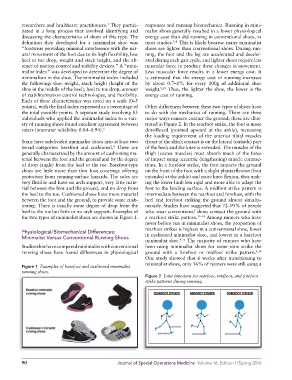
          points), with the final index expressed as a percentage of   Other differences between these two types of shoes have
          the total possible points. A separate study involving 85   to do with the mechanics of running. There are three
          individuals who applied the minimalist index to a vari-  major ways runners contact the ground; these are illus-
          ety of running shoes found excellent agreement between   trated in Figure 2. In the rearfoot strike, the foot is more
          raters (interrater reliability 0.84–0.94). 3       dorsiflexed  (pointed  upward  at  the  ankle),  increasing
                                                             the loading requirement  of the anterior  tibial muscles
          Some have subdivided minimalist shoes into at least two   (front of the shin); contact is on the lateral (outside) part
                                                4
          broad  categories:  barefoot  and  cushioned.   These  are   of the heel; and the knee is extended. The muscles of the
          generally characterized by the amount of cushioning ma-  thigh (vastus muscles) must absorb much of the force
          terial between the foot and the ground and by the degree   of impact using eccentric (lengthening) muscle contrac-
          of drop (angle) from the heel to the toe. Barefoot-type   tions. In a forefoot strike, the foot impacts the ground
          shoes are little more than thin foot coverings offering   on the front of the foot with a slight plantarflexion (foot
          protection from running-surface hazards. The soles are   extended at the ankle) and more knee flexion, thus mak-
          very flexible and have no arch support, very little mate-  ing the lower limb less rigid and more able to adapt the
          rial between the foot and the ground, and no drop from   foot to the landing surface. A midfoot strike pattern is
          the heel to the toe. Cushioned shoes have more material   intermediate between the rearfoot and forefoot, with the
          between the foot and the ground, to provide some cush-  heel and forefoot striking the ground almost simulta-
          ioning. There is usually some degree of drop from the   neously. Studies have suggested that 72–95% of people
          heel to the toe but little or no arch support. Examples of   who wear conventional shoes contact the ground with
          the two types of minimalist shoes are shown in Figure 1.  a rearfoot strike pattern. 11–14  Among runners who have
                                                             never before run in minimalist shoes, the proportion of
                                                             rearfoot strikes is highest in a conventional shoe, lower
          Physiological/Biomechanical Differences:           in cushioned minimalist shoe, and lowest in a barefoot
          Minimalist Versus Conventional Running Shoes
                                                             minimalist shoe. 4,15  The majority of runners who have
          Studies that have compared minimalist with  conventional   been using minimalist shoes for some time strike the
          running shoes have found differences in physiological   ground with a forefoot or midfoot strike pattern. 6,14
                                                             One study showed that 6 weeks after transitioning to
                                                             minimalist shoes, only 36% of runners were still using a
          Figure 1  Examples of barefoot and cushioned minimalist
          running shoes.
                                                             Figure 2  Joint functions for rearfoot, midfoot, and forefoot
                                                             strike patterns during running.


          90                                      Journal of Special Operations Medicine  Volume 16, Edition 1/Spring 2016

