


Page 118 - Journal of Special Operations Medicine - Winter 2015
P. 118
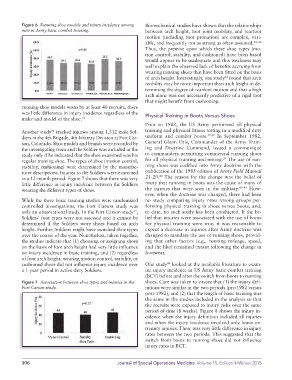
Figure 6  Running shoe models and injury incidence among   Biomechanical studies have shown that the relationships
          men in Army basic combat training.                 between arch height, foot joint mobility, and rearfoot
                                                             motion (including foot pronation) are complex, vari-
                                                             able, and frequently not as strong as often assumed. 34–36
                                                             Thus, the premise upon which these shoe types (mo-
                                                             tion control, stability, and cushioned) have been based
                                                             would appear to be inadequate and this weakness may
                                                             well explain the observed lack of benefits accruing from
                                                             wearing running shoes that have been fitted on the basis
                                                             of arch height. Interestingly, one study  found that arch
                                                                                              34
                                                             mobility may be more important than arch height in de-
                                                             termining the degree of rearfoot motion and that a high
                                                             arch alone was not necessarily predictive of a rigid foot
                                                             that might benefit from cushioning.
          running-shoe models worn by at least 40 recruits, there
          was little difference in injury incidence regardless of the   Physical Training in Boots Versus Shoes
          make and model of the shoe. 32
                                                             Prior  to  1982,  the  US  Army  performed  all  physical
          Another study  tracked injuries among 1,332 male Sol-  training and physical fitness testing in a modified duty
                      33
          diers in the 4th Brigade, 4th Infantry Division at Fort Car-  uniform and combat boots. 37,38  In September 1982,
          son, Colorado. Shoe models and brands were recorded by   General Glenn Otis, Commander of the Army Train-
          the investigating team and the Soldier was included in the   ing and Doctrine Command, issued a communiqué
          study only if he indicated that the shoe examined was his   to commanders permitting commercial running shoes
                                                                                             39
          regular training shoe. The types of shoe (motion control,   for all physical training and testing.  The use of run-
          stability, cushioning) were determined by the manufac-  ning shoes was codified into Army doctrine with the
          turer descriptions. Injuries to the Soldiers were examined   publication of the 1985 edition of Army Field Manual
                                                                   40
          in a 12-month period. Figure 7 shows that there was very   21-20.  The reason for the change was the belief of
          little difference in injury incidence between the Soldiers   many that running in boots was the cause of many of
          wearing the different types of shoes.              the injuries that were seen in the military. 41–43  How-
                                                             ever, when the doctrine was changed, there had been
          While the three basic training studies were randomized   no study comparing injury rates among groups per-
          controlled investigations, the Fort Carson study was   forming physical training in shoes versus boots, and,
          only an observational study. In the Fort Carson study ,   to date, no such study has been conducted. If the be-
                                                        33
          Soldiers’ foot types were not assessed and it cannot be   lief that injuries were associated with the use of boots
          determined if the Soldiers wore shoes based on arch   for physical training were true, it was reasonable to
          height. Further, Soldiers might have switched shoe types   expect a decrease in injuries after Army doctrine was
          over the course of the year. Nonetheless, taken together,   changed to mandate the use of running shoes, provid-
          the studies indicate that (1) choosing or assigning shoes   ing that other factors (e.g., running mileage, speed,
          on the basis of foot arch height had very little influence   and the like) remained extant following the change in
          on injury incidence in basic training, and (2) regardless   footwear.
          of foot arch height, wearing motion control, stability, or
                                                                      44
          cushioned shoes did not influence injury incidence over   One study  looked at the available literature to exam-
          a 1-year period in active-duty Soldiers.           ine injury incidence in US Army basic combat training
                                                             (BCT) before and after the switch from boots to running
          Figure 7  Association between shoe types and injuries in the   shoes. Care was taken to ensure that (1) the injury defi-
          Fort Carson study.                                 nitions were similar in the two periods (pre-1982 versus
                                                             post-1982), and (2) that the length of basic training was
                                                             the same in the studies included in the analysis so that
                                                             the recruits were exposed to injury risks over the same
                                                             period of time (8 weeks). Figure 8 shows the injury in-
                                                             cidence when the injury definition included all injuries
                                                             and when the injury incidence involved only lower ex-
                                                             tremity injuries. There was very little difference in injury
                                                             rates between the two periods. This suggested that the
                                                             switch from boots to running shoes did not influence
                                                             injury rates in BCT.


          106                                    Journal of Special Operations Medicine  Volume 15, Edition 4/Winter 2015

