


Page 112 - Journal of Special Operations Medicine - Winter 2015
P. 112
include leukopenia, usually lymphopenia along with   obtained by bronchoscopy are not possible, both naso-
          thrombocytopenia, and elevated lactate dehydrogenase   pharyngeal and oropharyngeal specimens should be ob-
          and transaminase levels.  Risk factors for severe illness   tained.  Various DoD laboratories located in the United
                               2
                                                                   5
          include immunosuppression, obesity, diabetes, and pre-  States, Republic of Korea, Germany, and the Middle
          existing heart, lung, or kidney disease.  In addition to   East are equipped for MERS-CoV testing and are listed
                                            2
          comorbidities, severe illness and mortality appear to be   in the DoD guideline. 5
          associated with low albumin concentration, age older
          than 65 years, and development of concomitant infec-  Management
          tions, particularly ventilator-acquired respiratory infec-
          tions.  The mean time from onset of symptoms until   Upon suspecting a case of MERS, providers should
               2
          death is 11.5 days. 2                              immediately provide the patient with a medical mask,
                                                             place the patient on droplet and contact precautions,
                                                             and ensure strict universal precautions by providers.
                                                                                                            4
          Diagnosis
                                                             If possible, MERS patients should be placed in an ad-
          Infection  with  MERS-CoV  generally  should  be  sus-  equately ventilated single room away from other patient
          pected in patients presenting with a febrile respiratory   care areas.  If patients receive treatments that risk aero-
                                                                      4
          illness who have had either a recent travel history to   solization of pathogens (including nebulizer treatments,
          the Arabian Peninsula or neighboring countries, or who   high-flow nasal cannula, and chest physiotherapy), they
          had contact with a traveler with fever and respiratory   should additionally be placed on airborne precautions.
                                                                                                            4
          symptoms.  Additionally, symptomatic patients with a   Because there are no proven therapies for MERS-CoV,
                   5
          history of being in a healthcare facility in the Republic   management is largely supportive.  Hypoxia should be
                                                                                           4
          of Korea should also be suspected.  The Department of   managed with supplemental oxygen, high-flow devices,
                                        5
          Defense (DoD) Armed Forces Health Surveillance Cen-  and mechanical ventilation, if necessary. Hemodynamic
          ter provides guidelines for the detection and reporting of   support may also be required with intravenous fluid re-
          cases of MERS-CoV infection.  This guideline references   suscitation and vasopressors; however, in the absence of
                                    5
          the Centers for Disease Control and Prevention (CDC)   shock, intravenous fluids should be given judiciously to
          and World Health Organization guidelines for case defi-  avoid respiratory impairment.  Empiric corticosteroids
                                                                                       4
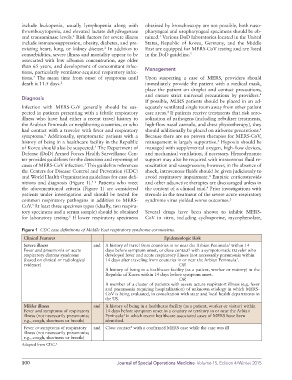
          nitions and diagnosis (Figure 1).  Patients who meet   and other adjunctive therapies are discouraged unless in
                                       4–6
          the aforementioned criteria (Figure 1) are considered   the context of a clinical trial.  Prior investigations with
                                                                                      4
          patients under  investigation and should be tested  for   steroids in the treatment of the severe acute respiratory
          common respiratory pathogens in addition to MERS-  syndrome virus yielded worse outcomes. 2
          CoV. At least three specimen types (ideally, two respira-
              5
          tory specimens and a serum sample) should be obtained   Several drugs have been shown to inhibit MERS-
          for laboratory testing.  If lower respiratory specimens   CoV in vitro, including cyclosporine,  mycophenolate,
                              5
          Figure 1  CDC case definitions of Middle East respiratory syndrome coronavirus.
           Clinical Features                                         Epidemiologic Risk
           Severe illness               and  A history of travel from countries in or near the Arbian Peninsula  within 14
                                                                                               1
                                                                               2
           Fever and pneumonia or acute      days before symptom onset, or close contact  with a sympotomatic traveler who
           respiratory distress syndrome     developed fever and acute respiratory illness (not necessarily pneumonia within
                                                                                                   1
           (based on clinical or radiological   14 days after traveling from countries in or near the Arbian Peninsula .
           evidence)                                                       OR
                                             A history of being in a healthcare facility (as a patient, worker or visitory) in the
                                             Republic of Korea within 14 days before symptom onset.
                                                                           OR
                                             A member of a cluster of patients with severe acture respiratort illness (e.g. fever
                                             and pneumonia requiring hospitalization) of unknown etiology in which MERS-
                                             CoV is being evaluated, in consultation with state and local health departments in
                                             the US.
           Milder illness               and  A history of being in a healthcare facility (as a patient, worker or visitor) within
           Fever and symptoms of respiratory   14 days before symptom onset in a country or territory in or near the Arbian
           illness (not necessarily pneumonia;   Peninsula  in which recent healthcare-associated cases of MERS have been
                                                    1
           e.g., cough, shortness or breath)  identified.
                                                       2
           Fever or symptoms of respiratory   and  Close contact  with a confirmed MERS case while the case was ill
           illness (not necessarily pneumonia;
           e.g., cough, shortness or breath)
          Adapted from CDC. 6


          100                                    Journal of Special Operations Medicine  Volume 15, Edition 4/Winter 2015

