


Page 55 - Journal of Special Operations Medicine - Fall 2015
P. 55
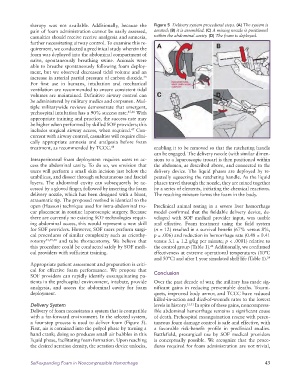
therapy was not available. Additionally, because the   Figure 5  Delivery system procedural steps. (A) The system is
              pain of foam administration cannot be easily assessed,   aerated; (B) it is assembled. (C) A mixing nozzle is positioned
              casualties should receive receive analgesia and amnesia,   within the abdominal cavity. (D) The foam is deployed.
              further necessitating airway control. To examine this re-
              quirement, we conducted a preclinical study wherein the
              foam was deployed into the abdominal compartment of
              naïve, spontaneously breathing swine. Animals were
              able to breathe spontaneously following foam deploy-
              ment, but we observed decreased tidal volume and an
              increase in arterial partial pressure of carbon dioxide.
                                                            25
              For first use in humans, intubation and mechanical
              ventilation are recommended to ensure consistent tidal
              volumes are maintained. Definitive airway control can
              be administered by military medics and corpsmen. Mul-
              tiple militarywide reviews demonstrate that emergent,
              prehospital intubation has a 90% success rate. 45,46  With
              appropriate training and practice, the success rate may
              be higher when performed by skilled SOF providers; this
              includes surgical airway access, when required.  Con-
                                                       47
              current with airway control, casualties will require clini-
              cally appropriate amnesia and analgesia before foam
              treatment, as recommended by TCCC. 48              enabling it to be removed so that the ratcheting handle
                                                                 can be engaged. The delivery nozzle (with similar dimen-
              Intraperitoneal foam deployment requires users to ac-  sions to a laparoscopic trocar) is then positioned within
              cess the abdominal cavity. To do so, we envision that   the abdomen, as described above, and connected to the
              users will perform a small skin incision just below the   delivery device. The liquid phases are deployed by re-
              umbilicus, and dissect through subcutaneous and fascial   peatedly squeezing the ratcheting handle. As the liquid
              layers.  The  abdominal  cavity  can  subsequently  be  ac-  phases travel through the nozzle, they are mixed together
              cessed by a gloved finger, followed by inserting the foam   by a series of elements, initiating the chemical reactions.
              delivery nozzle, which has been designed with a blunt,   The resulting mixture forms the foam in the body.
              atraumatic tip. The proposed method is identical to the
              open (Hasson) technique used for intra-abdominal tro-  Preclinical animal testing in a severe liver hemorrhage
              car placement in routine laparoscopic surgery. Because   model confirmed that the fieldable delivery device, de-
              there are currently no existing SOF technologies requir-  veloped  with  SOF  medical  provider  input,  was  usable
              ing abdominal access, this would represent a new skill   and  effective.  Foam  treatment  using  the  field  system
              for SOF providers. However, SOF users perform surgi-  (n = 12) resulted in a survival benefit (67% versus 8%,
              cal procedures of similar complexity such as cricothy-  p = .006) and reduction in hemorrhage rate (0.48 ± 0.41
              rotomy 45,49,50  and tube thoracostomy. We believe that   versus 3.1 ± 1.2 g/kg per minute; p < .0001) relative to
              this procedure could be conducted safely by SOF medi-  the control group (Table 1).  Additionally, we confirmed
                                                                                        24
              cal providers with sufficient training.            effectiveness at extreme operational temperatures (10°C
                                                                 and 50°C) and after 1 year simulated shelf life (Table 1). 24
              Appropriate patient assessment and preparation is criti-
              cal for effective foam performance. We propose that   Conclusion
              SOF providers can rapidly identify exsanguinating pa-
              tients in the prehospital environment, intubate, provide   Over the past decade of war, the military has made sig-
              analgesia, and access the abdominal cavity for foam   nificant gains in reducing preventable deaths. Tourni-
              deployment.                                        quets, improved body armor, and TCCC have reduced
                                                                 killed-in-action and died-of-wounds rates to the lowest
              Delivery System                                    levels in history. 12,51  In spite of these gains, noncompress-
              Delivery of foam necessitates a system that is compatible   ible abdominal hemorrhage remains a significant cause
              with a far-forward environment. In the selected system,   of death. Prehospital exsanguination rescue with percu-
              a four-step process is used to deliver foam (Figure 5).   taneous foam damage control is safe and  effective, with
              First, air is entrained into the polyol phase by turning a   a  favorable  risk-benefit  profile  in  preclinical   studies.
              hand crank; doing so produces small air bubbles in this   Battlefield, presurgical use by SOF medical providers
              liquid phase, facilitating foam formation. Upon reaching   is conceptually possible. We recognize that the proce-
              the desired aeration density, the aeration device unlocks,   dures required for foam administration are not trivial,


              Self-expanding Foam in Noncompressible Hemorrhage                                               43

