


Page 71 - Journal of Special Operations Medicine - Winter 2014
P. 71
before   practicing at their previous level of clinical and   the leadership desired to incorporate end-user feedback
              surgical performance.  With the advances in technology   to increase the likelihood of participation, acceptance,
                                11
              and training aids, many have called upon the role of sim-  and utility of the program.
              ulation as a sustainable, ethical, effective, and affordable
              method to maintain and improve medical skills, espe-
              cially those that are not common in everyday practice. 12–14  Methods

                                                                 Survey Design
              Similarly, advances in distributed learning have shown   To evaluate SFMS’ perceptions of the current medical
              promise in individualizing medical education and provid-  sustainment program and the need for any change to the
              ing training to Groups in different geographical areas. A   program, a survey instrument was created to assess their
              computer-based learning environment has been adopted   attitudes about the current program and perceived bar-
              by the JSOMTC for use by SFMS during the Q-Course   riers and self-efficacy of sustaining their medical skills.
              with the goal of continuing access following graduation.   Survey best practices were used to improve the validity
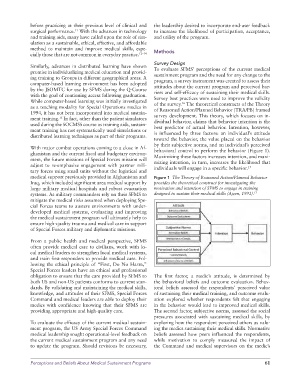
              While computer-based learning was initially investigated   of the survey.  The theoretical constructs of the Theory
                                                                            16
              as a teaching modality for Special Operations medics in   of Reasoned Action/Planned Behavior (TRA/PB) framed
              1994, it has not been incorporated into medical sustain-  survey development. This theory, which focuses on in-
              ment training.  In fact, other than the patient simulators   dividual behavior, claims that behavior intention is the
                          15
              used during the SOCMSS course as training aids, sustain-  best predictor of actual behavior. Intention, however,
              ment training has not systematically used simulations or   is influenced  by three  factors: an individual’s attitude
              distributed learning techniques as part of their programs.
                                                                 toward the behavior, the value placed on the behavior
                                                                 by their subjective norms, and an individual’s perceived
              With major combat operations coming to a close in Af-  behavioral control to perform the behavior (Figure 1).
              ghanistan and the current fiscal and budgetary environ-  Maximizing these factors increases intention, and maxi-
              ment, the future missions of Special Forces mission will   mizing intention, in turn, increases the likelihood that
              adjust to re-emphasize engagement with partner mili-  individuals will engage in a specific behavior. 17
              tary forces using small units without the logistical and
              medical support previously provided in Afghanistan and   Figure 1  The Theory of Reasoned Action/Planned Behavior
              Iraq, which included significant area medical support by   provides the theoretical construct for investigating the
              large military medical hospitals and robust evacuation   motivation and intention of SFMS to engage in training
              systems. As military commanders rely on their SFMS to   designed to sustain their medical skills (Ajzen, 1991). 17
              mitigate the medical risks assumed when deploying Spe-
              cial Forces teams to austere environments with under-
              developed medical systems, evaluating and improving
              the medical sustainment program will ultimately help to
              ensure high-quality trauma and medical care in support
              of Special Forces military and diplomatic missions.

              From a public health and medical perspective, SFMS
              often provide medical care to civilians, work with lo-
              cal medical leaders to strengthen local medical systems,
              and train first responders to provide medical care. Fol-
              lowing the ethical principle of “First, Do No Harm,”
              Special Forces leaders have an ethical and professional
              obligation to ensure that the care provided by SFMS to   The first factor, a medic’s attitude, is determined by
              both US and non-US patients conforms to current stan-  the behavioral beliefs and outcome evaluation. Behav-
              dards. By validating and maintaining the medical skills,   ioral  beliefs assessed the respondents’ perceived value
              knowledge, and attitudes of their SFMS, Special Forces   of sustaining their medical training, and outcome evalu-
              Command and medical leaders are able to deploy their   ation explored whether respondents felt that engaging
              medics with confidence knowing that their SFMS are   in the behavior would lead to improved medical skills.
              providing appropriate and high-quality care.       The second factor, subjective norms, assessed the social
                                                                 pressures associated with sustaining medical skills, by
              To evaluate the efficacy of the current medical sustain-  exploring how the respondent perceived others as valu-
              ment program, the US Army Special Forces Command   ing the medics sustaining their medical skills. Normative
              medical leadership sought operational-level feedback on   beliefs assessed how peers influenced the respondents,
              the current medical sustainment program and any need   while motivation to comply measured the impact of
              to update the program. Should revisions be necessary,   the  Command and medical supervisors on the medic’s


              Perceptions and Beliefs About Medical Sustainment Programs                                      61

